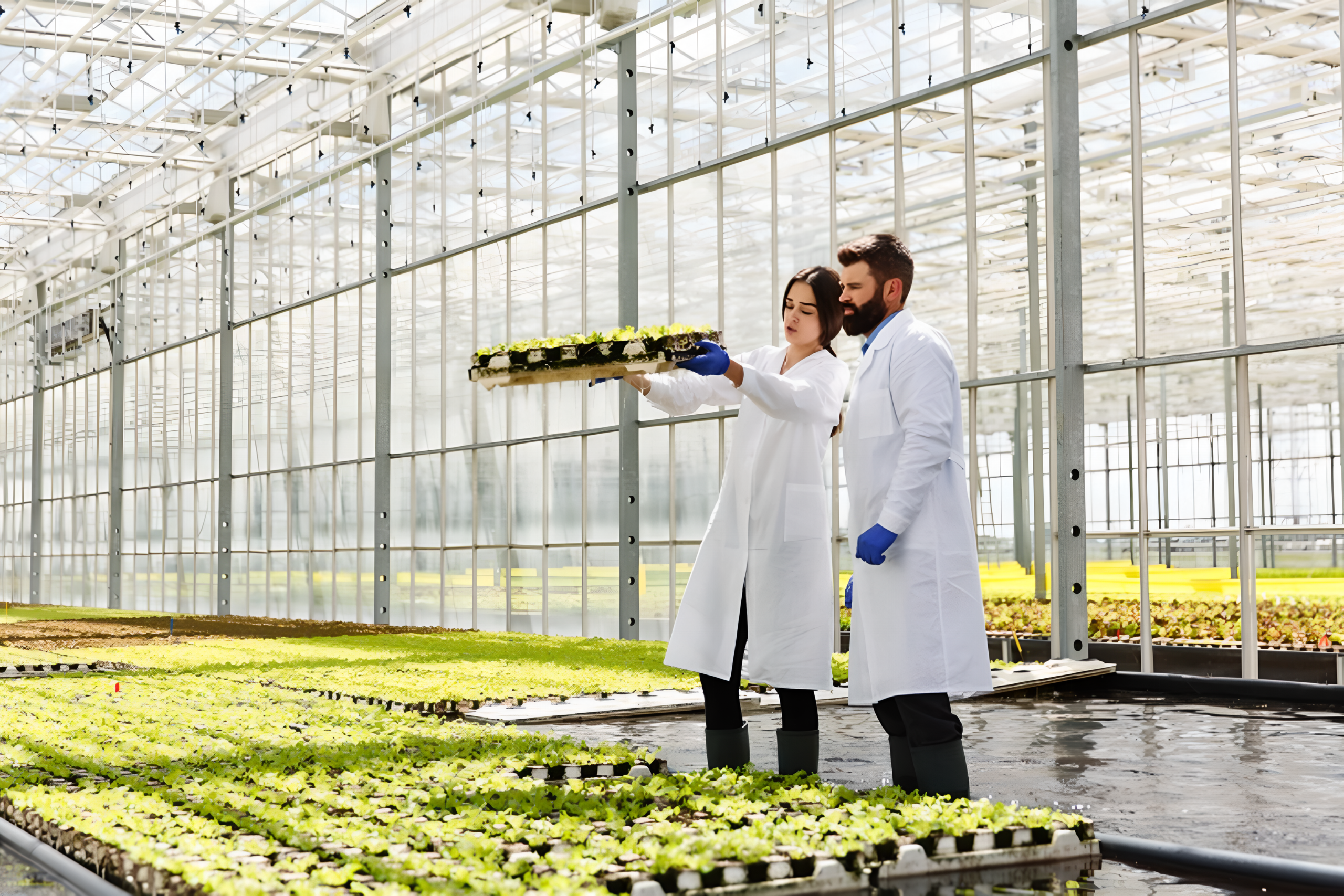
Hydroponics in an industrial greenhouse has long ceased to be an experiment: at large operations the technology has displaced soil for tomatoes, cucumbers, peppers and leafy crops. Precise control of nutrition, higher yield per square metre, less water and fertiliser per kilogram of produce. Below we look at which hydroponic systems are used, which material goes under the crop and how fertigation is set up.
What hydroponics is and why an industrial greenhouse needs it
Hydroponics is growing without soil: the roots receive NPK, calcium, magnesium and trace elements from a solution through an inert carrier. Commercial hydroponics removes the instability of soil, gives control of nutrition at the level of the solution and increases planting density.
Types of hydroponic systems for industrial greenhouses
NFT (Nutrient Film Technique)
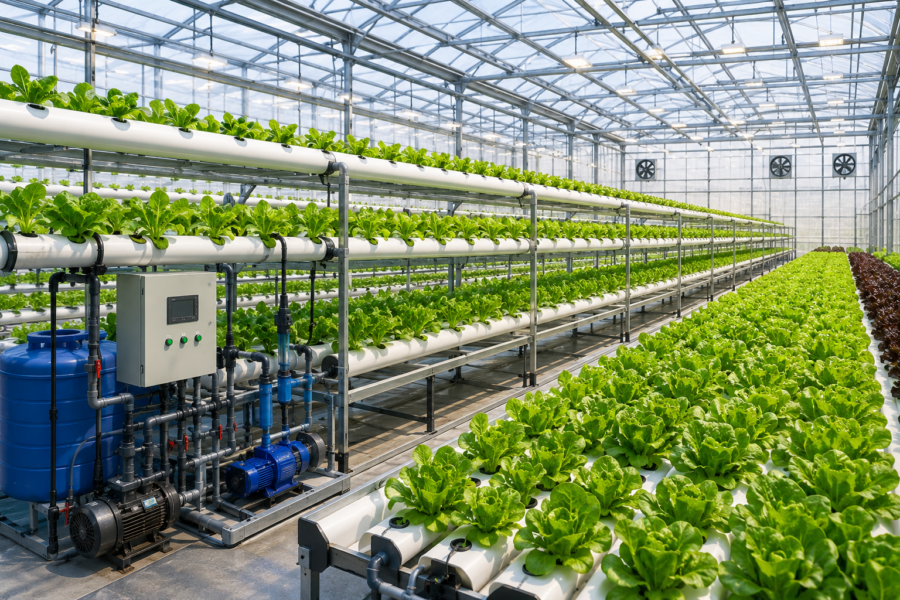
The solution flows in a 1–3 mm layer along channels with a slope of 1–2%. Used for lettuce, rocket and basil. The downside: if the pump stops, the roots dry out within 30–40 minutes.
DWC (Deep Water Culture)
The roots sit in an aerated solution 20–30 cm deep. In industrial greenhouses it is used less often than NFT: it takes more space and the aerators consume energy.
Drip irrigation on substrate
The dominant hydroponic technology for vegetables: tomatoes, cucumbers, peppers and strawberries. The plant sits in a rockwool or coir slab with a 2–4 l/h dripper for each one. Irrigation runs 4–12 times a day.
Ebb and Flow
The trays are flooded with solution for 3–5 minutes, after which it drains back into the tank. Used for seedlings and for growing on leafy greens; rarely in the main cycle.
Substrates for commercial hydroponics
Rockwool: advantages and specifics
The basic industrial material. Slabs of 100×20×7.5 or 100×20×10 cm: high water-holding capacity and even water release. The downsides are that it is single-use and difficult to dispose of. For tomatoes and cucumbers it is the industry standard.
Coir substrate: slabs and chips
Coir substrate for hydroponics is made from processed coconut husk, in slabs or loose. Coir slabs are often chosen for tomatoes on a long cycle: the material is softer than rockwool. Buffering the coir is critical: untreated coir releases Na+ and K+ and throws off the EC of the solution, so before use it is flushed with a calcium solution. Coir substrate lasts 2–3 cycles in a greenhouse.
Perlite, vermiculite, expanded clay
Additives or the base for seedling trays. Perlite is light and aerating, vermiculite holds water, expanded clay is used in DWC and large pots. In industrial projects they are rarely used on their own.
How to choose a substrate for the crop
| Crop | Substrate | Service life |
| Tomato, long cycle | Rockwool, coir | 1 cycle |
| Cucumber, pepper | Rockwool, coir | 1–2 cycles |
| Lettuce, leafy greens | NFT without substrate | – |
| Strawberry | Coir | 1–2 cycles |
Fertigation — nutrition and irrigation in one system
Fertigation in a greenhouse combines irrigation and the delivery of fertilisers. A fertigation system consists of mixing tanks A and B, dosing pumps, EC and pH controllers, an acid injection unit, filters and the pipework to the drippers.
Composition of the nutrient solution (NPK plus trace elements)
The nutrient solution is calculated for the crop and the growth stage. For a tomato in fruiting: N 200–240, P 50–60, K 300–350, Ca 180–200, Mg 50–60 ppm. Trace elements (Fe, Mn, Zn, Cu, B, Mo) are at ppb level.
EC and pH: target values and control
The controller maintains EC and pH in fertigation automatically:
| Crop | EC, mS/cm | pH |
| Tomato | 2.5–3.2 | 5.5–6.2 |
| Cucumber, pepper | 2.0–2.8 | 5.5–6.2 |
| Lettuce, leafy greens | 1.2–1.8 | 5.8–6.2 |
| Strawberry | 1.5–2.0 | 5.8–6.2 |
Drainage: the EC is 0.3–0.8 mS/cm higher than at the inlet, the pH 0.2–0.5 lower. A larger gap means salt is accumulating in the root zone.
Drip irrigation and dosing units
Drip irrigation and fertigation go together. The standard is pressure-compensated drippers of 2 l/h (cucumbers, tomatoes) and 3–4 l/h (long cycle). Proportional dosing units deliver A and B plus acid to the set EC and pH.
Recirculation and closed systems
Open scheme: the drainage goes to the sewer — simpler but more expensive. Closed: the drainage is collected, disinfected by UV or filtration, corrected for EC and pH and returned to the supply. Fertiliser consumption falls by 20–40% and water by up to 50%.
What hydroponics gives a commercial grower
Yield and quality
Hydroponic technology delivers a consistent size grade, an even batch and a long shelf life. With the right system the yield per square metre is 20–50% higher.
Control of resources: water, fertiliser, labour
With recirculation the water consumption per kilogram of produce is 4–10 times lower than in soil. Fertilisers go to the root zone without losses, and there is less weeding and less work when the season changes.
Payback of the project
It depends on the crop, the volume and the selling price. We do not quote specific figures — we calculate them individually for the customer’s business model.

What to pay attention to when starting a hydroponic project
- The quality of the incoming water: Na+, Cl–, EC, hardness, bacteriology;
- The crop and the varieties — the material and the solution parameters follow from them;
- The electrical capacity — pumps and climate equipment create a serious peak load;
- The area and geometry of the greenhouse — the pipework layout and zoning;
- The operating budget for fertilisers, slab replacement and supplementary lighting.
Frequently asked questions
Which hydroponic system suits tomatoes and cucumbers?
Drip irrigation on rockwool or coir slabs. NFT and DWC are not used for these crops: a heavy plant and a long cycle need support and a stable root zone.
How many times can coir substrate be used?
With proper treatment between seasons, 2–3 cycles. Rockwool is single-use.
Can an existing greenhouse be converted from soil to hydroponics?
Technically yes. It requires work on the floor, the irrigation pipework, a water treatment unit, dosing units and a controller. The payback is faster than new construction because the frame is retained.
Which is better: an open or a closed system?
A closed one is cheaper to run but requires tighter control of water quality and a disinfection unit. For large volumes we recommend recirculation.
Turnkey hydroponic complexes from NIVA GREENTECH
If you are planning the construction of turnkey greenhouse complexes with hydroponics or an upgrade of an existing facility, we will help to calculate the configuration for the crop and the volume. Our own plant and our experience of completed facilities allow us to cover the whole cycle — from concept to commissioning. Related reviews are in other articles on the blog.