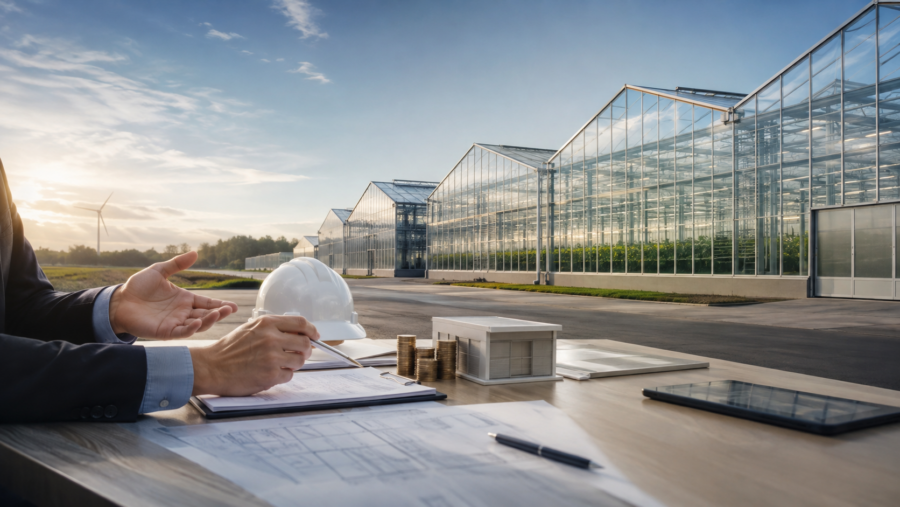
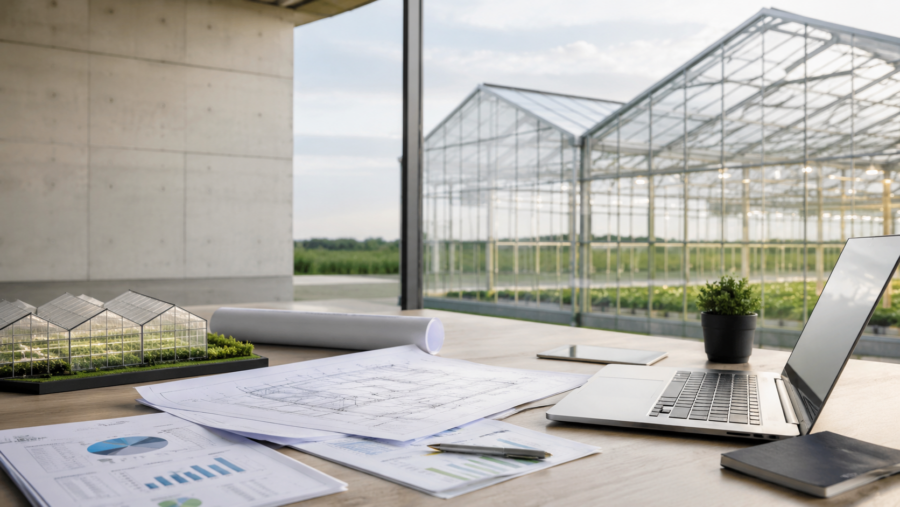
Industrial film greenhouses are one of the most widespread formats in the greenhouse business in Russia and the CIS. Their popularity comes from relatively affordable initial investment and fast construction, which makes them attractive both to start-ups in the agricultural sector and to established businesses planning to expand.
This type of structure is often seen as a logical first step or a scaling tool, thanks to the possibility of developing the project in stages and adapting it to different crops. Behind the apparent simplicity and economy, however, lie operating nuances that directly affect the financial result.
Many investors base their decision on simplified marketing calculations that often leave out the full range of operating costs and risks. As a result, expectations of profitability and of the payback period of a film greenhouse do not always match the real performance of the business. The aim of this article is to review the technological and economic aspects objectively, setting out not only the advantages but also the systemic limitations of the format, in order to show under which conditions such projects really do become profitable and when choosing them may carry financial risk.
What industrial film greenhouses are and how they differ from other formats
Industrial film greenhouses are permanent structures intended for commercial growing of agricultural crops on areas, as a rule, from 1,000 m². Their key structural feature is the use of a special polymer film as the translucent envelope instead of traditional glass or polycarbonate. The frame of such greenhouses is made of steel structures (most often galvanised steel) designed for significant snow and wind loads, which is what places them in the industrial segment.
What distinguishes the industrial format from farm or small greenhouses is, first of all, the scale and the degree of engineering equipment. While small greenhouses often manage with a minimal set of equipment, an industrial complex implies a basic climate control system (heating, ventilation, screening), an irrigation system (most often drip) and lighting. The main difference from classic Venlo glass greenhouses lies in the covering material. Glass provides maximum light transmission and durability, but it is considerably more expensive and requires a heavier frame. Film is an economy-class material with a shorter service life, but using it radically reduces capital costs and allows facilities to be built and upgraded quickly.
Such a result is only achieved with a comprehensive approach that includes design, factory manufacturing of the frame, turnkey supply of the engineering systems and account of regional specifics. It is this that moves a film structure out of the category of seasonal covers and into the category of industrial assets capable of delivering a steady crop.

The main advantages of industrial film greenhouses
Choosing film greenhouses is justified by a number of strategic advantages that are critical in certain business scenarios.
- A comparatively low investment threshold. The capital cost of building one hectare of a quality film greenhouse can be 1.5–2.5 times lower than that of a Venlo glass equivalent. This is a key factor for investors with a limited budget or for testing a new market niche;
- Speed of design and construction. Standardised solutions and lighter structural elements shorten the time from the start of design to commissioning. This makes it possible to start production and earn the first revenue sooner, which has a positive effect on overall payback;
- Flexible scaling of the area. The structures allow production capacity to be increased relatively easily in modules. A business can start with a few blocks and expand as the production processes are refined and sales markets take shape;
- Adaptation to different crops and regions. Modern film coverings (light-stabilised, heat-retaining, anti-condensate) and the variety of frame designs make it possible to grow a wide range of crops efficiently, from tomatoes and cucumbers to leafy greens and berries, in different climate zones;
- Ease of upgrading in stages. The infrastructure of such a greenhouse allows gradual improvement. You can start with basic systems and then, as profit grows, invest in additional automation and climate control, raising overall profitability.
It is precisely this combination of affordability, speed and flexibility that makes industrial film greenhouses a popular solution for launching a greenhouse business, expanding existing areas or organising seasonal production in regions with a mild climate.
Limitations and drawbacks that are often left unsaid
To form an objective picture it is necessary to consider the technological and operating limitations of the format, which directly affect running costs.
- Dependence on the quality of the film and on its replacement schedule. Film is a consumable with a limited service life (usually 3–7 years depending on the type and manufacturer). It has to be replaced regularly, which is a planned but substantial cost item. Poor-quality or damaged film sharply reduces light transmission and insulation, with a negative effect on yield;
- Limits on energy efficiency. The insulating properties of a film covering are inferior to modern double glazing or twin-wall polycarbonate. In regions with severe winters, or for year-round production, this leads to higher energy consumption for heating, which can eat up a significant part of the revenue;
- The influence of climate and seasonality. In strong winds, hail or heavy snowfall the risk of damage to the covering increases. Without additional heating and supplementary lighting, efficient production is often limited to the light and warm part of the year, which narrows the window for earning profit;
- Higher demands on operation and control. The microclimate in a film greenhouse is less stable than in a glass one and reacts faster to changes in external conditions. This requires closer monitoring and prompt manual control of the ventilation and heating systems, or investment in advanced automation;
- Risks related to design and installation. The strength of the whole structure depends directly on correct load calculations and the quality of installation. Errors at these stages can lead to deformation of the frame or frequent tears in the film, increasing unforeseen costs.
Ignoring these drawbacks at the planning stage is a common reason why the real financial performance of a project differs from expectations.
Factors that directly affect the payback of a film greenhouse
The payback period of a film greenhouse is not a fixed value. It is shaped by a set of interrelated factors that have to be modelled before investing in a greenhouse complex.
- The choice of crop and growing technology. The profitability of growing tomatoes, cucumbers, leafy greens or lettuce differs radically. It depends on the market price, the yield per square metre, the length of the cycle and the required level of technology (supplementary lighting, nutrient solution systems).
- The climate zone and the length of the season. In southern regions, where greenhouses can be used for long periods without expensive heating, payback comes sooner. In central and northern regions the cost of energy for year-round operation can make a project economically unviable.
- The level of automation. Initial investment in automatic climate control, irrigation and screening systems increases capital costs, but in the long run it reduces operating risks, minimises the human factor and can increase yields by 15–30%, speeding up the return on investment.
- The quality of design and construction. A sound design that accounts for all snow and wind loads, correct selection of equipment and professional installation are insurance against future emergency shutdowns and unplanned repairs. Saving at these stages almost always leads to higher total costs.
- The cost of energy (gas, electricity). This is one of the largest variable cost items. Tariff dynamics should be a key element of the financial model.
- Logistics and sales channels. Distance from major markets or the absence of established sales channels (retail chains, wholesalers) increases transport costs and may force the crop to be sold at reduced prices, cutting the margin.
Real payback periods: why the figures «from the adverts» do not work
Advertising promises of a payback period of 2–3 years for a film greenhouse are not uncommon on the market. Such figures are possible in ideal conditions, but in practice they are rarely achieved. The main reason lies in simplified calculations that do not take the full range of costs and risks into account.
The following items are most often understated or left out:
- The cost of site preparation and utility connections (gas, electricity, water), which can amount to 20–30% of the cost of the greenhouse block itself;
- Staff costs, taxes, product certification and administrative expenses;
- The cost of regular film replacement and other consumables;
- A reserve for unforeseen costs and emergencies (equipment breakdowns, extreme weather);
- Working capital for buying seeds, fertilisers and plant protection products before the first crop is sold.
The real payback period of an investment in a greenhouse complex is shaped not by the type of greenhouse but by the thoroughness of the business planning. For a well-designed and well-built film complex growing high-margin crops seasonally in a favourable climate zone, a realistic payback period may be 4–6 years. For year-round production in regions with expensive energy this period can stretch to 7–10 years or more, calling into question any economic advantage over other formats.

When industrial film greenhouses are a justified choice
Despite the limitations, there are a number of scenarios in which choosing film greenhouses is strategically and economically justified:
- Launching a greenhouse business on a limited budget. It minimises the initial capital investment, lets you refine the growing technology and enter the market with minimal financial risk;
- Expanding an existing agricultural holding or farm. For quickly increasing the area for a particular order or a new crop without raising large-scale long-term finance;
- Regions with a mild climate (southern Russia, some parts of the CIS), where greenhouses can be used effectively to extend the season or run a winter–spring cycle with moderate heating costs;
- Projects developed in stages, where the investor plans to start with a minimal configuration and then, as profit comes in and the market becomes clearer, invest step by step in upgrading the covering, in automation or in moving to a year-round cycle.
When alternative greenhouse formats are worth considering
In some situations choosing film technology from the outset can lead to higher total costs in the long run. Glass or polycarbonate greenhouses (of the Venlo type, for example) are worth considering if:
- The key goal is stable year-round production in regions with a continental climate. The high energy efficiency and durability of alternative coverings compensate over time for the higher initial investment through significant savings on heating and the absence of regular film replacement costs;
- The project is intended as a long-term investment (over 10 years) and requires maximum stability of the production process. Glass greenhouses provide consistently high light transmission and a more predictable microclimate throughout their service life;
- The crop being grown places exceptionally high demands on the stability of temperature, humidity and light (certain berries or flowers, for example);
- The investor is prepared for more substantial initial investment in order to minimise operating risks and obtain a premium product.
Industrial film greenhouses are not a universal solution, but they are an extremely important and sought-after one for agribusiness in Russia and the CIS. A low entry threshold, speed of construction and flexibility make them an ideal tool for entering the industry, scaling quickly or running seasonal production in suitable climatic conditions.
Their choice, however, has to be based on careful analysis. The drawbacks related to the durability of the covering, energy efficiency and the higher demands on operation have to be built into the financial model from day one. The real payback of greenhouses and their ultimate profitability depend not so much on the type of structure as on a combination of factors: sound design and construction, the chosen crop, regional specifics, the cost of resources and the quality of management.
The success of a project is therefore determined not by the choice between «film» and «glass» but by the depth of work on the business plan and the production programme, in which the type of greenhouse is one of many tools for achieving economic goals.