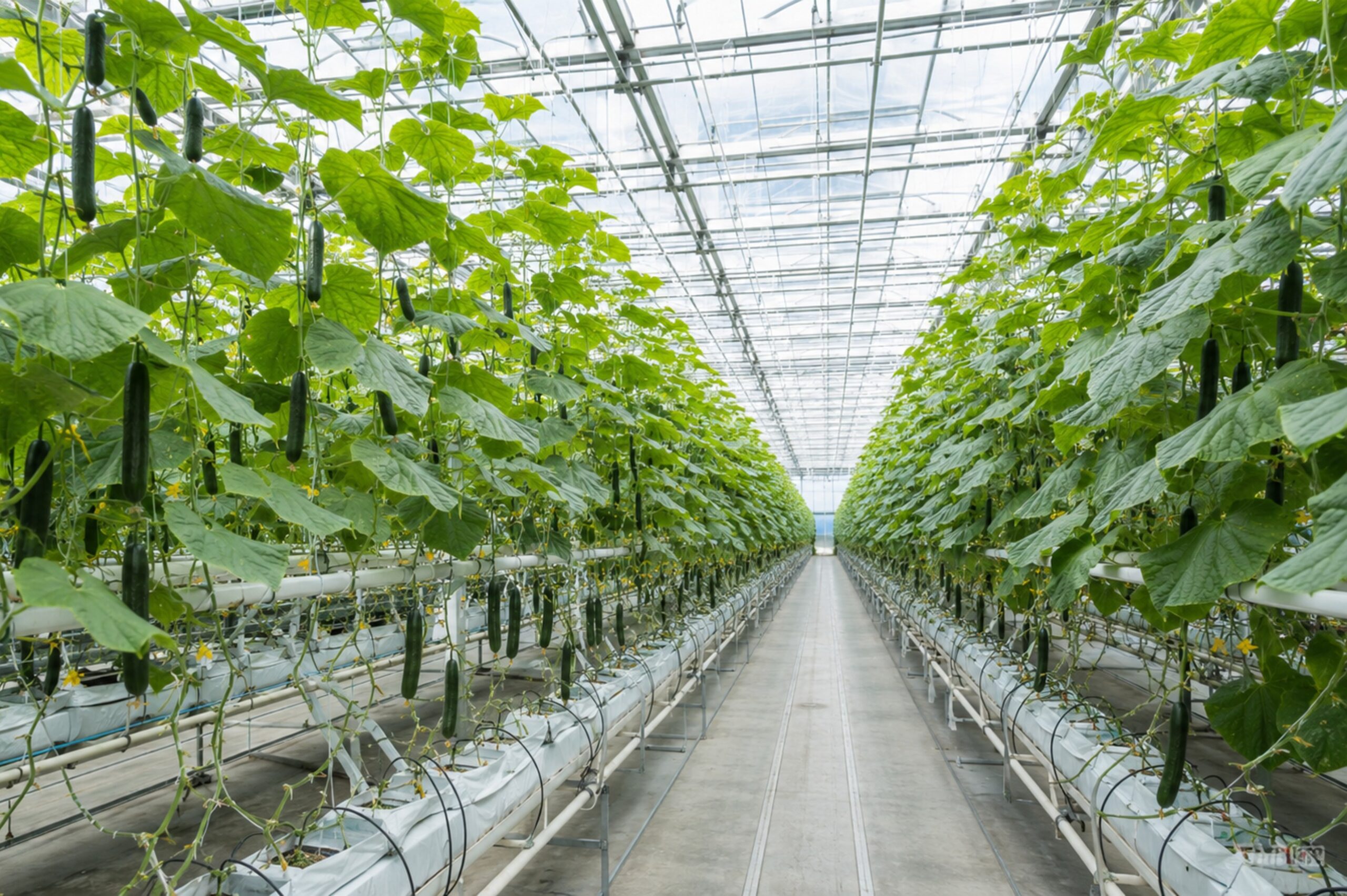
An industrial greenhouse for cucumbers is more than a frame with a covering. The cucumber needs a stable microclimate, controlled humidity, adjustable ventilation, precise irrigation and well-designed heating. An error in any system makes the structure ineffective even when the steel is of good quality.
At the pre-design stage a grower chooses more than a kit: the frame, the engineering systems, the automation and the operating regime are selected for the variety. Commercial cucumbers are grown in multi-span film and in glass complexes, and the format follows from the area, the seasonality and the technology.
Below is a practical review for agronomists, technologists and farm managers.
In brief: what kind of greenhouse cucumbers need
- A high trellis system and a margin in the ridge height;
- Controlled humidity and ridge ventilation without draughts;
- Stable heating throughout the cycle;
- Drip irrigation with fertigation for the substrate or hydroponics;
- Automation and climate control for a precise regime;
- A design made for the area, the region and the seasonality.
Why cucumbers require their own design logic
The cucumber is sensitive to swings in temperature and humidity. The root zone needs a constant supply of oxygen and the leaf needs an even microclimate without draughts. The plant uses water intensively, requires nutrition for every cycle and reacts badly to condensation.
A universal model for every crop does not work: the tomato needs more active air exchange, leafy greens need a short turnaround and gutter planting. Cucumbers for industrial greenhouses are built into the design separately, with a calculation for stable humidity and precise irrigation.
Which structural parameters to consider first
Designing a facility for cucumbers starts with the calculation of the regime. The frame profile is selected later, for a crop that is already known. The main parameters are the ridge height, the trellis height, the air volume, the span width, the row layout and the covering.
Height, trellis and air volume
Commercially grown cucumbers are trained on a trellis system. The higher the ridge, the greater the air volume above the planting and the better a stable microclimate is maintained. A high trellis leaves room for several layerings without losing light. On multi-span farm facilities a margin in height is built in so that the planting does not reach the roof by the middle of the cycle.
Frame, covering and light transmission
The steel frame of a multi-span greenhouse is protected with an anti-corrosion coating; the profile section and the column spacing are designed for the loads of the region. In the north the spacing is reduced and the profile thickness increased.
The covering determines the light transmission and the thermal insulation. Double film provides an industrial envelope at an acceptable budget. Polycarbonate walls add rigidity and make operation easier. Venlo glass suits large intensive projects. The film format is covered in the section on industrial film greenhouses.
Microclimate in a cucumber greenhouse
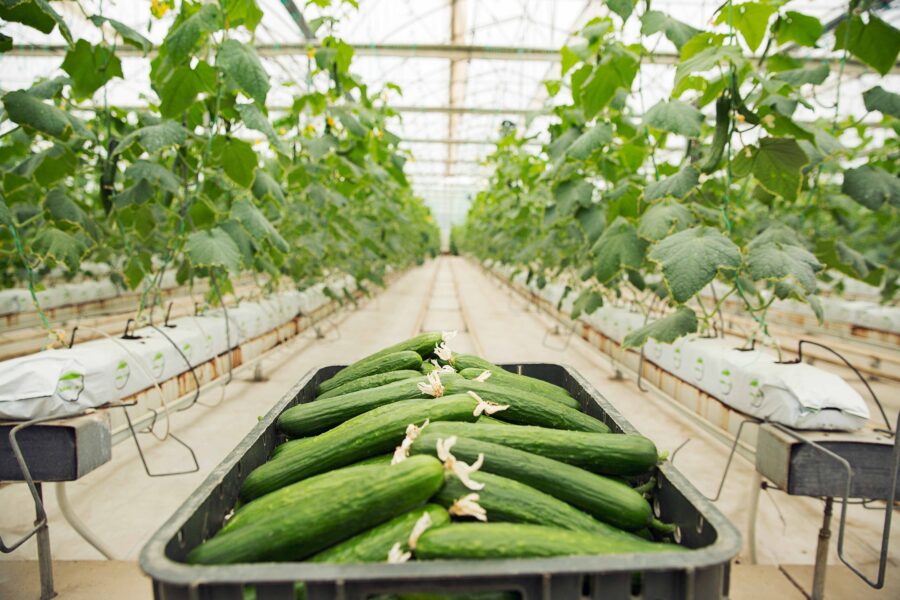
The microclimate is the main factor of success. The cucumber is sensitive to temperature swings, condensation and stagnant humidity. With insufficient ventilation the risk of leaf disease grows; with excessive ventilation the plant loses moisture and the yield falls.
- The temperature is held within a narrow band between the day and night regimes;
- Humidity is kept within the working range without sharp swings;
- Air exchange — ridge and side ventilation without draughts;
- Condensation is removed by the automation and by the heating settings;
- Screens stabilise the readings and reduce heat losses.
The exact values are agreed with the agronomist. On the design side the systems that run the scenario on schedule are provided for.
Engineering systems for commercial cucumber growing
The engineering is divided into several circuits: heating, air exchange, root zone nutrition, removal of excess and control. The package is selected for the variety, the seasonality and the area.
- Heating: boiler house, main circuit, pipes under the trellis;
- Ventilation: ridge and side, with automatic control;
- Irrigation: drip supply with precise dosing;
- Fertigation: delivery of the nutrient solution according to the growing technology;
- Drainage: removal of excess and protection against stagnation;
- Automation: a single circuit for all the systems;
- Supplementary lighting and CO2 supply for intensive technology and year-round operation.
Irrigation, fertigation and drainage
Commercially grown cucumbers are not watered by hand. Drip irrigation with fertigation delivers the solution exactly to the root zone, and the automation runs the regime from sensor data. On substrate or hydroponics the nutrition is calculated for the variety and the growth stage. Manual supply over a large area cannot hold the microclimate: the yield falls.
Industrial film greenhouse or Venlo: what to choose for cucumbers
Both formats are used in commercial cucumber growing, but with a different equipment package and a different starting price.
| Format | When it suits | Advantages for cucumbers | Limitations |
| Multi-span film | Medium and large farm facilities, seasonal and year-round production | Flexibility on timing, a moderate start, suitable height for the trellis | The film has to be replaced on schedule; a year-round cycle requires well-designed heating |
| Venlo glass | Large automated complexes, year-round cycle, intensive technology | Durable covering, stable climate, precise automation | Higher initial investment; a separate budget for the automation |
| Farm tunnel | Simple seasonal tasks, berries, leafy greens | Economical start | Does not always provide an industrial level of microclimate for cucumbers |
Table 1. Greenhouse formats for commercial cucumber growing.
The final choice follows from the area, the seasonality, the crop and the budget. Most vegetable projects are built on multi-span film. A glass complex is used for large intensive tasks. A tunnel is rarely chosen for cucumbers.
What data is needed to cost a cucumber greenhouse
A commercial proposal requires the following input:
- The cucumber hybrid and the planned cycle;
- The planned area and the site;
- The region of construction, the snow and wind loads;
- Seasonality: seasonal, extended-season or year-round production;
- Technology: substrate, rockwool, coir, hydroponics;
- Requirements for the engineering systems;
- Utilities: electricity, water, gas or alternative sources;
- The planned start-up dates.
On the basis of this input comes greenhouse complex design: load calculations, selection of the structure, the composition of the engineering and the scope of work.
Typical mistakes when choosing a greenhouse for cucumbers
Mistakes at the pre-design stage cost more — they are harder to correct after start-up:
- A backyard approach to a commercial facility — a 1,000 m² block is not assembled by the logic of a 3×6 kit;
- Underestimated ventilation — weak air exchange increases the risk of leaf disease;
- Weak heating — the microclimate drifts in cold weather;
- No drainage — stagnant solution hits the yield;
- A frame without calculations — under snow and wind the structure loses its geometry;
- Buying an industrial greenhouse «at the price of the frame» — without engineering the facility does not work.
Frequently asked questions
Which greenhouse suits commercial cucumber growing?
Most often a multi-span film greenhouse with a high trellis system, heating, ridge ventilation and drip irrigation with fertigation. Large intensive projects go to Venlo with automation and climate control.
Does a cucumber greenhouse need heating?
For a year-round cycle, yes. Without heating the microclimate cannot be held in cold weather and the cycle is interrupted. For seasonal production part of the heating equipment may be left out.
Can cucumbers and tomatoes be grown in the same greenhouse?
In theory yes, but the regimes differ. The cucumber has higher requirements for humidity, the tomato for air exchange and light. Most growers in practice separate the crops into different compartments with their own automation.
How does a multi-span film greenhouse differ from Venlo for cucumbers?
Film solves most vegetable tasks at a moderate budget. Venlo is a glass envelope with precise climate control and a high level of automation for large projects. The format is chosen by the area, the regime and the technology.
What is needed for a calculation?
The cucumber variety, the area, the region, the seasonality, the technology, the requirements for the engineering, the utilities on the site and the start-up dates. This data is used to prepare the estimate and a preliminary proposal.
Industrial greenhouse for cucumbers from NIVA GREENTECH
We design and build industrial greenhouses for cucumbers: we select the structure for the region, put together the engineering for the variety and run the facility from the calculation to commissioning. The work is carried out through construction of greenhouse complexes. Send us the hybrid, the area and the seasonality — we will prepare a calculation and a proposal.