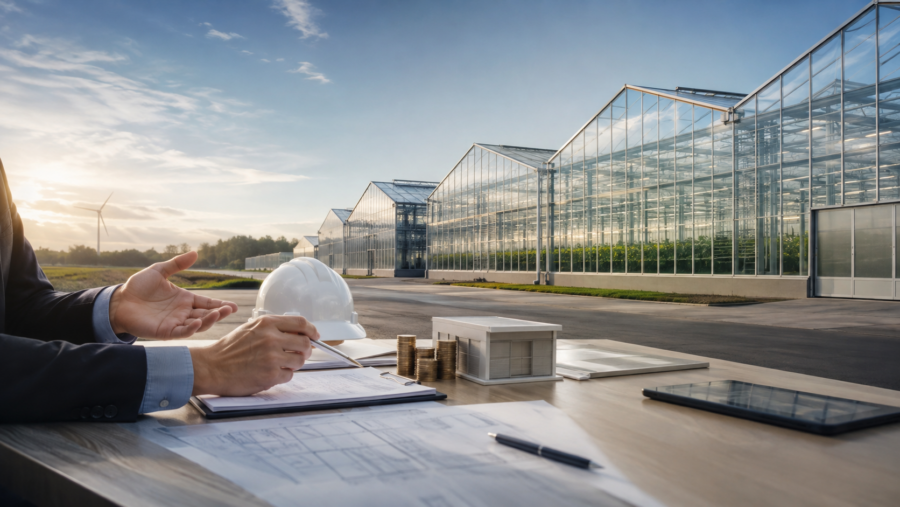
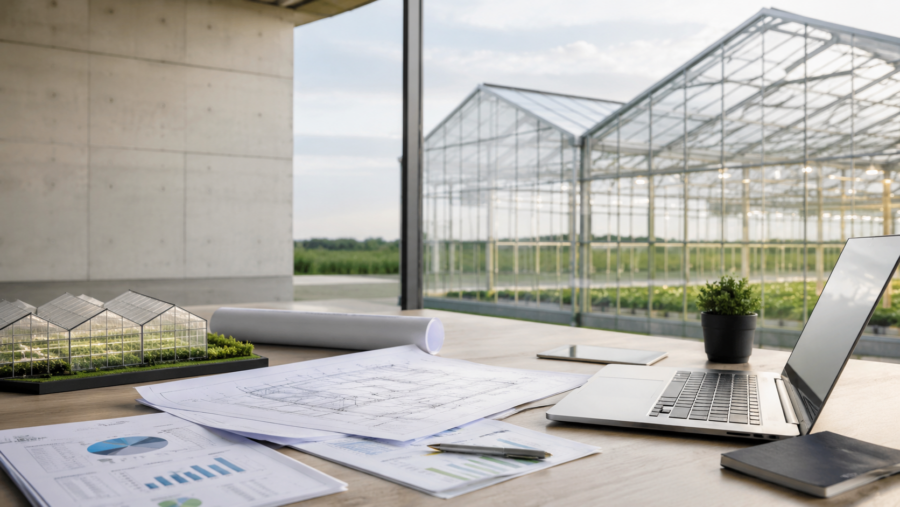
An industrial greenhouse for leafy greens is chosen with the crop, the growing technology, the seasonality, the area and the required output in mind. For commercial production it is important to consider not only the frame but the complex as a whole: the structure, the climate systems, irrigation, fertigation, supplementary lighting, automation and the production areas.
A greenhouse for growing leafy greens must provide stable conditions for salad crops throughout the whole cycle. That is why the growing technology and the requirements for the future facility are defined before construction, and only then are the structure and the equipment selected.
Which structure to choose for commercial growing of leafy greens and lettuce
The structure of a greenhouse complex depends on its scale, on the requirements for climate control and on the planned operating regime. Commercial growing of leafy greens uses various types of protected cultivation, including industrial film structures and Venlo glass greenhouses.
The choice is made not on a single parameter but on a combination of factors: the crop, the region, the seasonality, the level of automation and the available engineering resources.
| Type of structure | What it suits | Level of automation | Engineering requirements | Limitations |
| Industrial film greenhouse | Facilities with different levels of equipment and a defined production programme | Depends on the equipment package of the facility | Heating, ventilation, irrigation and automation have to be calculated | The capabilities are set by the chosen structure and equipment |
| Venlo | Intensive commercial production with a high level of microclimate control | Suitable for comprehensive automation | Requires detailed work on climate systems, engineering and control | Requires full design work for the particular task |
An industrial greenhouse for lettuce has to be designed as a single facility. The structure affects the placement of equipment, the efficiency of ventilation, the possibility of installing supplementary lighting and the subsequent maintenance.
It is also important to allow for future expansion. If the business plans to increase its output, this must be provided for at the design stage.
To determine the best solution, greenhouse complex design is used, where the structural and technological decisions are tied to the production task.
Soil, substrate or hydroponics: how to choose the technology
Different growing technologies can be used for leafy greens and salad crops. The choice depends on the goals of the project, on how controllable the process needs to be and on the available resources.
Growing in soil requires soil preparation and control of the agronomic parameters. With a substrate the plants get a more controllable environment, while hydroponic technologies allow more precise control of the water and nutrient supply.
Hydroponics is often used in commercial projects with a high degree of production control, but it requires the appropriate engineering infrastructure: water treatment, equipment for supplying the nutrient solution and a system for managing the growing parameters.
A detailed review of the equipment, substrates and fertigation is given in the article «Hydroponics in an industrial greenhouse: systems, substrates and fertigation».
When choosing the technology it is important to consider not only the growing method but the entire production process, from raising the seedlings to the finished produce.
Which engineering systems and production areas are needed
A greenhouse complex for leafy greens involves more than the growing area alone. For the facility to work steadily, the composition of the equipment and the auxiliary rooms has to be defined in advance.
The project may include:
- the plant growing area
- a propagation section where required
- irrigation and fertigation systems
- heating
- ventilation
- climate control
- supplementary lighting
- control automation
- technical rooms for the equipment
- areas for preparing and moving the produce
Irrigation and fertigation deliver water and nutrients in line with the chosen technology. The climate systems maintain the required conditions inside the greenhouse, while the automation helps to monitor the parameters and control the equipment.
The use of supplementary lighting is determined not only by the type of crop but also by the operating conditions of the facility. The design takes into account the region, the length of natural daylight, the seasonality of production and the required volume of output. If the greenhouse is intended for year-round operation and natural light is not sufficient, the artificial lighting system is selected separately according to the parameters of the particular project.
The composition of the engineering systems is covered in more detail in the article «Which engineering systems an industrial greenhouse needs».
What to take into account when designing and costing the complex
The input data has to be collected before the structure and the equipment are chosen. This makes it possible to determine the right technology and to avoid a mismatch between the production plans and what the facility can actually do.
Costing an industrial greenhouse for leafy greens requires:
- the crops and the planned product range
- the area of the complex
- the region of construction
- the seasonality of operation
- the growing technology
- the available energy resources
- the requirements for supplementary lighting
- the required level of automation
- the planned output
On the basis of this data the composition of the facility is determined: the type of structure, the engineering systems, the production areas and the equipment required.
For example, an industrial lettuce greenhouse running all year round will require more detailed work on climate, heating, lighting and automation than a seasonal facility. The technical solution therefore has to match the business model of the production.
Once the concept has been prepared, the project can move to implementation. NIVA GreenTech carries out the construction of greenhouse complexes in line with the chosen technology and equipment package.
FAQ
Can leafy greens be grown in an industrial greenhouse all year round?
Yes, provided the facility is designed for year-round operation. This requires the necessary microclimate, heating, ventilation, irrigation and other engineering systems. Where natural light is insufficient, supplementary lighting may be needed.
What to choose for lettuce: soil or hydroponics?
The choice depends on the production task. Soil-based technology may be used in some projects, and hydroponics in others, where tighter control of the water and nutrient supply is required. The decision is made with the crop, the scale of production and the available infrastructure in mind.
Is supplementary lighting needed for commercial growing of leafy greens?
Not always. The need for supplementary lighting is determined by the region, the season, the crop and the requirements for output. If a year-round cycle with constant output is planned, the lighting system is calculated together with the other engineering solutions.
What does the cost of a greenhouse complex for leafy greens and lettuce depend on?
The cost depends on the area, the structure, the growing technology, the composition of the engineering systems, the level of automation, the site preparation and the equipment package. The calculation is therefore carried out once the input data and the requirements for the future facility have been defined.