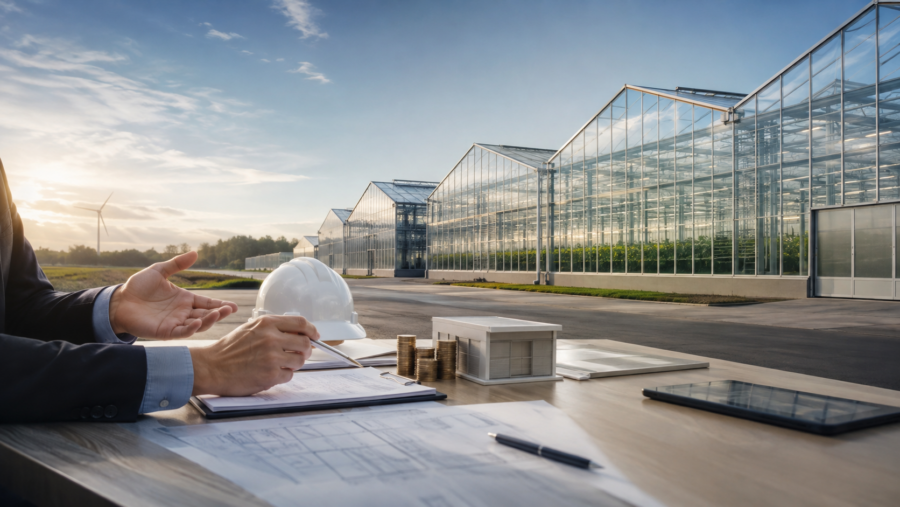
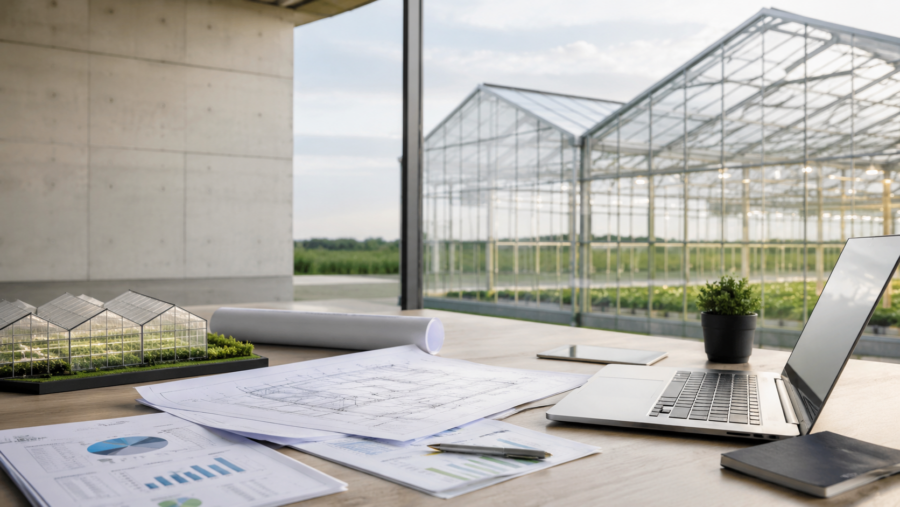
The tomato responds to every decision in the design. Trellis height, light transmission, the rate of air exchange, the precision of fertigation — all of it directly affects the cycle, the fruiting and the resistance to disease. An industrial greenhouse for tomatoes is therefore an engineering facility with its own calculations for the structure and the systems, not an «enlarged farm tunnel».
Below we go through the parameters worth settling before any steel and film are bought.
Why a properly designed industrial greenhouse matters for tomatoes
Tall hybrids have a long cycle and a large vegetative mass. They need height for the trellis, a stable microclimate and precise delivery of nutrients. If the structure is low, the light is poor and the ventilation cannot cope, the cycle breaks down and the yield becomes erratic.
Which structural parameters to consider first
Ridge height and trellis height
For indeterminate tomatoes the ridge height is set with a margin — for the trellis and for the growth of the plant. A structure that is too low limits the cycle and makes it harder to work with the upper part of the plants.
Span width and row layout
The span width determines how many rows fit without losing light and how convenient it is to work with machinery. A dense layout reduces the yield, a sparse one increases the cost per square metre of produce.
Snow and wind loads
The frame is calculated for the climate of the site. The snow load in central regions differs from the south, and the wind load differs between continental and coastal areas. This calculation goes into the steel and the spacing of the arches.
Materials of an industrial tomato greenhouse
When the question is which material industrial greenhouses use, the answer depends on the crop, the budget and the intended service life.
Galvanised steel frame
The basic frame material is galvanised steel. It carries the design loads, needs no frequent treatment and lasts for decades. The joints are selected according to the span and the type of covering.
Double film, polycarbonate walls and light transmission
Double film with air inflation works as a thermal layer and reduces heat losses. Polycarbonate walls protect the sides against wind and mechanical impact. The light transmission is selected for the crop: the tomato is demanding of light, especially in winter.
When to consider a Venlo glass structure
Venlo glass provides high light transmission and stable geometry. This structure pays off on large year-round facilities with deep automation. For a seasonal task the film option usually wins.
Engineering systems: what steady tomato growing requires
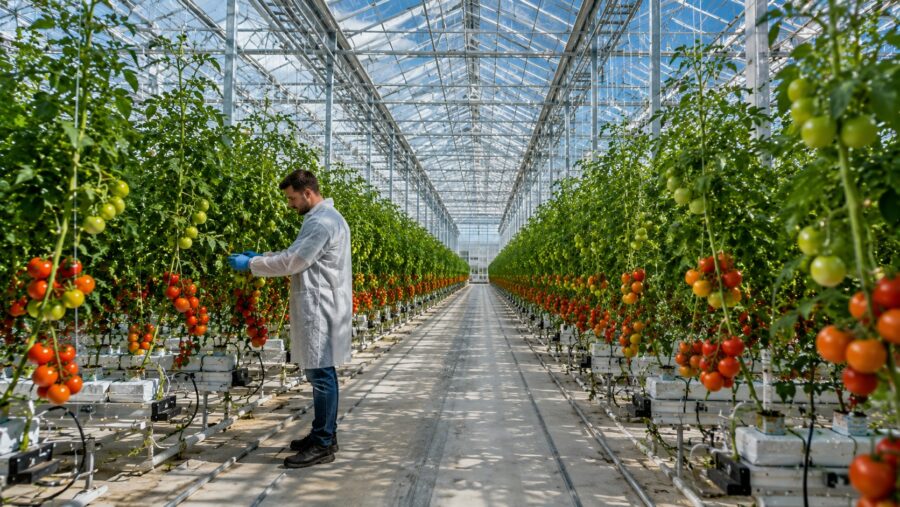
The engineering is the «second frame» of the facility. The systems of an industrial greenhouse are selected as a single circuit, not as a set of separate solutions.
Ventilation, cooling and humidity control
Side and ridge ventilation remove excess heat and moisture. In hot weather cooling and forced air are brought in — Active Climate keeps the microclimate within the range that suits pollination and fruit filling.
Heating and even heat distribution
Heating works not only in winter — it stabilises night temperatures between seasons. The circuits are arranged so that the heat spreads evenly, without «cold spots» near the walls.
Drip irrigation, fertigation and nutrition control
Drip irrigation with fertigation doses water and nutrients according to the stage of the crop. Commercial growing rests on exactly this circuit — with coir slabs or rockwool and precise drainage control.
Supplementary lighting and CO2 enrichment in a year-round cycle
Year-round operation is impossible without supplementary lighting — natural light is not sufficient in winter. CO2 enrichment strengthens photosynthesis, but it only works together with ventilation and climate control.
Industrial film greenhouse or Venlo: which to choose for tomatoes
| Parameter | Industrial film | Venlo glass | Farm tunnel |
| Operating horizon | Long, shoulder seasons or all year | Long, year-round | Seasonal |
| Light transmission | High with double film | Maximum | Medium |
| CAPEX | Medium | Higher | Lower |
| Automation | Up to a deep level | Deep, as standard | Minimal |
| Suitable for | Tall hybrids | Tall hybrids, all year | Early varieties |
Most vegetable projects use industrial film greenhouses — a balance of CAPEX and capability. Venlo industrial greenhouses are appropriate where maximum stability of the light regime matters.
Why an industrial greenhouse should not be designed «by yourself»
Assembling an industrial greenhouse on your own looks cheaper on paper but loses on substance. Without a load calculation the frame risks not surviving its first winter; without coordinated engineering the climate swings; and errors in the geometry only show up at harvest. This is a design with calculations and specifications, not a set of steel «from a photo».
Typical mistakes when choosing a greenhouse for tomatoes
- Ridge height set too low — shade from the structures and a limited cycle;
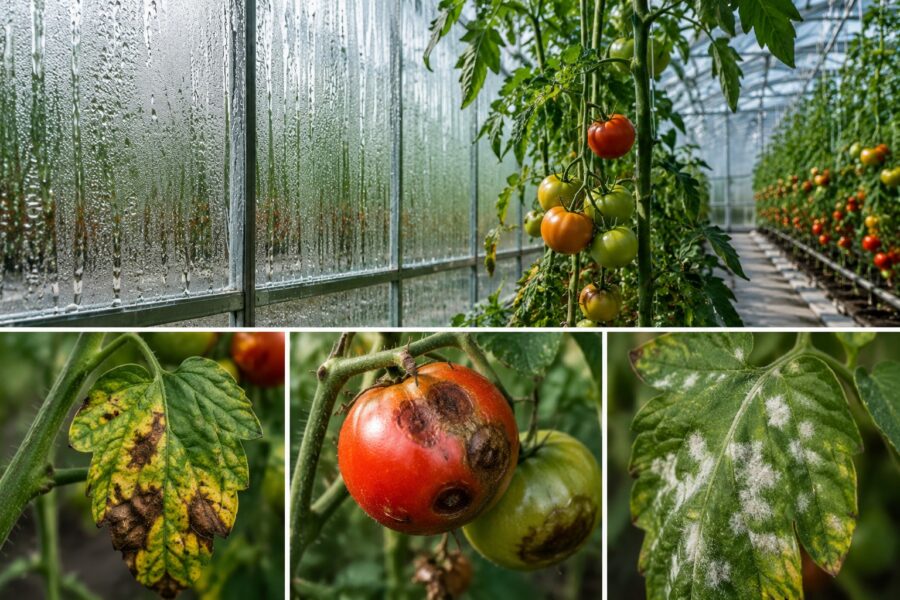
- Underestimated ventilation — overheating in summer, condensation and disease in autumn;
- Covering chosen without regard to winter light transmission — unstable fruit filling;
- Weak automation — manual climate control and the loss of an even regime;
- Irrigation without fertigation — uneven nutrition and inconsistent fruit grading;
- Buying steel without a design — rework and a missed season.
Frequently asked questions (FAQ)
What greenhouse height is needed for commercial tomatoes?
The ridge height is set with a margin for the trellis and for the movement of the plant. The exact figures are selected for the hybrid, the technology and the harvesting format — without the crop and the planting plan no correct number can be given.
Which is better for tomatoes: a film greenhouse or Venlo glass?
Each has its own scenario. Film suits most vegetable projects, Venlo suits large year-round facilities with deep automation. The choice depends on the operating horizon, the budget and the growing regime.
Which systems must be included in the design?
Climate control, ventilation, heating and drip irrigation with fertigation. A year-round cycle adds supplementary lighting, CO2 and extended automation — everything works as a single circuit.
Can one structure be used for both tomatoes and cucumbers?
Technically yes, but the regimes differ: temperature, humidity and the trellis format. Mixed growing loses part of the advantages of both crops — it is better to separate them into different compartments.
What does the cost of an industrial tomato greenhouse depend on?
On the area, the type of structure, the covering materials, the depth of automation and the composition of the engineering. An exact figure follows an analysis of the input data.
Industrial greenhouses for tomatoes from NIVA GREENTECH
For the tomato crop we calculate the structure, the engineering and the automation within a single project — from the ridge height to the fertigation circuits. We will advise which format fits the task: film, Venlo glass or another option from the catalogue of greenhouse solutions. To start the calculation, describe the crop, the target area, the region and the growing scenario.