The strawberry is a sensitive crop. Rain during flowering disrupts pollination, hail damages the fruit set and the leaves, and temperature swings shorten the season and pull down berry quality. Open field growing therefore remains a risky format even for experienced growers.
A high tunnel solves a large part of these problems: it takes away the impact of the weather, holds the temperature more steadily and helps to start harvesting earlier. In economic terms it is lighter than a year-round greenhouse, yet considerably more serious than a simple cover.
Below we look at what a strawberry tunnel gives, what the structure should be, how a tunnel differs from a farm greenhouse and a year-round complex, and which mistakes are most common when choosing a cover.
Why strawberries need a tunnel or a greenhouse
A tunnel or a greenhouse for berries is needed where the open field no longer does the job: the weather risks are too high, the season is too short or the market demands early and late berries. A cover changes the economics of the farm — not by magic, but by stabilising the cycle.
What a high tunnel gives a berry farm
A longer season and an earlier start to harvesting
Inside, the soil warms up earlier than in the open field, and the temperature holds longer in autumn. The harvesting season stretches at both ends, which means more selling windows and a higher price for berries out of season. More about the structure on the page high tunnels for berries.
Protection against rain, wind and hail
The covering keeps rain and hail away from the planting, and the wind load is carried by the frame rather than by the plants. For this crop that is critical during flowering and fruit filling.
Lower disease risk from excess moisture
Dry foliage and controlled humidity reduce the pressure from powdery mildew, grey mould and other diseases. Combined with drip irrigation under mulch this works particularly well.
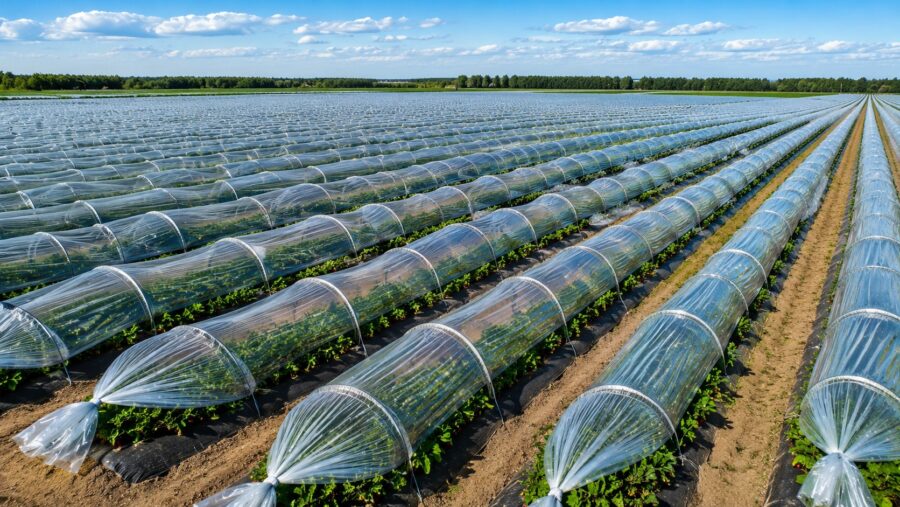
What a strawberry tunnel should be like
Width, height and access for machinery
The width and height of the tunnel are selected for the bed layout, the irrigation system and the passage of machinery. A narrow structure makes crop work harder, a low one heats unevenly and limits plant growth.
Frame, covering and ground anchoring
The frame is usually made of galvanised steel and the covering is film, designed for seasonal operation. Anchoring to the ground is done with screw piles or driven anchors, depending on the soil type and the wind load of the region.
Ventilation, doors and gutters
Side ventilation and roller end doors give control of the microclimate and access for machinery. The gutter system drains rain away from the rows and removes the risk of flooding between tunnels.
Tunnel, farm greenhouse or industrial complex: what to choose for strawberries
| Format | Seasonality | Protection against risks | CAPEX |
| Open field | Season only | Minimal | Low |
| High tunnel | Extended season | Rain, hail, wind, part of the diseases | Medium |
| Farm greenhouse | Season plus shoulder seasons | Wider, plus climate control circuits | Higher |
| Year-round complex | All year | Full control | High |
When a seasonal berry tunnel is enough
If the task is to extend the season, protect the planting from the weather and reduce losses, this format is usually sufficient. It is a sensible step up from the open field without moving into a capital-intensive project.
When a farm greenhouse with a fuller package is needed
When microclimate control, an early start and consistent berry quality are required, farm tunnel greenhouses come into consideration. The structure is more substantial, the engineering deeper and the season longer.
What to consider for year-round strawberry growing
A year-round strawberry greenhouse is already an industrial facility with heating, supplementary lighting, fertigation and automation. Its cost and complexity are comparable to a vegetable complex, and the decision is justified where the market is reliably prepared to pay for out-of-season berries.
Can a strawberry tunnel be built by yourself?
The question of how to build a strawberry tunnel yourself is a popular one, but for a serious farm this route rarely pays off. Without a calculation of the snow and wind loads the frame risks not surviving into a second season; without side ventilation it overheats in summer; and improvised ground anchoring gives way in the first strong wind. A home-made option suits a back garden, not a commercial scale.
Typical mistakes when choosing a greenhouse for strawberries
- A low cover — overheating under the film and restricted crop work;
- Weak ventilation — condensation, disease and the loss of part of the crop;
- A covering chosen without regard to light transmission — poor fruit filling out of season;
- No gutters — flooding and erosion between the rows;
- Improvised anchoring — the risk of the structure being torn loose in a squall;
- Buying a cover without matching it to the irrigation and mulching system.
Which strawberries suit growing in tunnels and greenhouses
A variety for a covered crop is chosen not by the principle of «the best strawberry for greenhouses» but by the technology, the market and the harvesting dates. Everbearing varieties work for a long season and suit tunnels with an extended cycle. Short-day varieties with frigo plants are convenient for managed harvest peaks. For year-round operation, varieties tolerant of prolonged supplementary lighting and a stable microclimate are chosen.
The same structures are often used for raspberries and blueberries — these crops have similar requirements for the cover and the engineering.

Frequently asked questions (FAQ)
How does a high tunnel differ from an ordinary strawberry greenhouse?
A high tunnel is a seasonal structure with film and basic ventilation, without heating or complex automation. An ordinary farm greenhouse for growing strawberries is more substantial in frame and engineering and gives more control over the climate.
Is a tunnel suitable for year-round growing?
No. It works in a seasonal and extended regime. Berries grow all year round only in a greenhouse with heating, supplementary lighting and stable automation.
Does a berry tunnel need heating?
Not in a standard tunnel — it works on natural heat. If the task is to run into the winter or to cover late spring frosts, a permanent greenhouse with engineering systems is required.
How can strawberries be protected from overheating under film?
Side ventilation, end doors, mulching and, in severe heat, shade nets. Drip irrigation and a sensible planting layout without «dead» unventilated zones help as well.
Which other berries can be grown in such tunnels?
Most often raspberries and blueberries. These crops are close to strawberries in their requirements for the cover and the engineering, so the same structure often serves several berry lines of a farm.
High tunnels for berries from NIVA GREENTECH
For berry crops we select the format of the cover — from a high tunnel to a year-round complex. We will advise which strawberry greenhouse suits the area, the market and the seasonal task of the farm; the options are in the catalogue of greenhouse solutions. To start the calculation, describe the crop, the area, the region and the season scenario — our team will put together an initial concept.