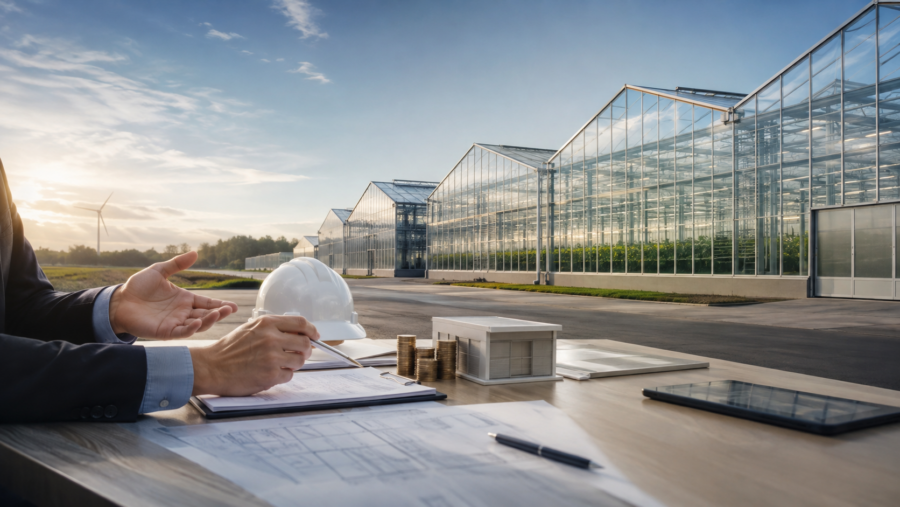
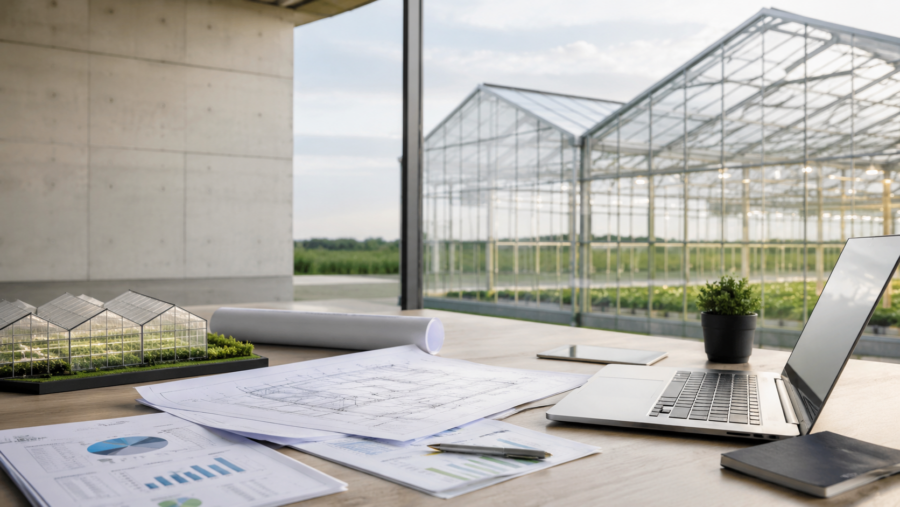
Farm tunnel greenhouses hold a special place among greenhouse structures. They are not as high-tech as multi-span industrial complexes and not as simple as backyard polycarbonate sheds. This is a working tool for a farm that earns its living growing vegetables, berries and leafy greens. Below are five specific advantages of tunnel greenhouses that explain their popularity with growers.
1. Low construction cost
The main advantage of a tunnel greenhouse is an affordable entry threshold. The structure is simpler than that of multi-span industrial complexes: a single arched frame of galvanised steel, a film covering and a minimum of engineering systems at the start.
The frame is assembled from reinforced flat-oval arches with a 63×52 mm section on 60×60×2 mm columns. The foundation is made of 50×50 mm galvanised piles. Installation takes less time than erecting a multi-span greenhouse with polycarbonate walls and an Active Climate system.
For a grower launching a greenhouse business or expanding an existing area, the difference in capital costs can determine whether the start is possible at all. A tunnel greenhouse makes it possible to begin growing and reach payback without raising large investment.
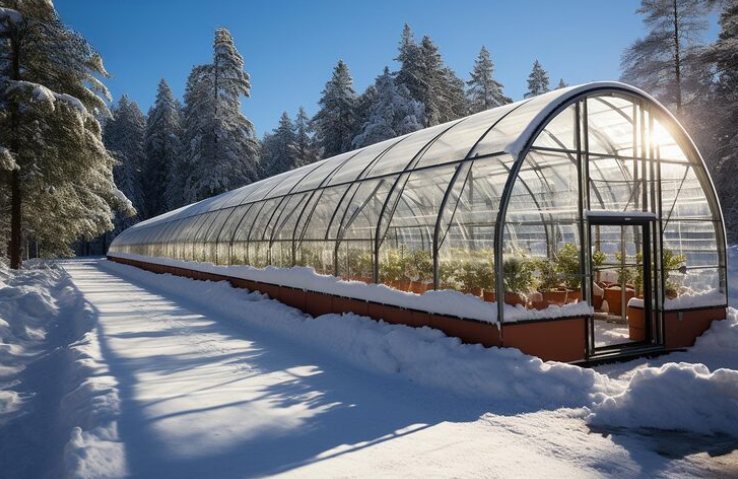
2. Year-round growing in any region
A tunnel greenhouse is designed for year-round operation — provided there is heating and supplementary lighting in winter. Double light-stabilised film 180 microns thick with inflation between the layers creates an air gap that works as insulation. The anti-condensate coating drains moisture away and stops drops falling onto the plants.
The structure is calculated for the snow and wind loads of the particular region. NIVA GREENTECH builds greenhouse complexes from the south of Russia to northern latitudes, as well as in the CIS countries. The film is supplied by proven manufacturers — Politiv (Israel), Plastika Kritis (Greece), Greenplastik (Turkey) — with a 5-year warranty.
This is not a seasonal cover but a full production facility for year-round work.
3. Protection from pests and weather
A tunnel greenhouse creates a closed environment that physically separates the plants from external threats. Insect screens on the ventilation openings keep pests out. The double film protects against hail, downpours and sharp temperature swings.
The inflation system between the layers of film not only improves insulation but also creates positive pressure that prevents small insects getting in through micro-gaps. As a result the cost of plant protection products falls noticeably, and the quality of the crop improves thanks to stable growing conditions.
For berry growers this matters especially. Strawberries and raspberries in a tunnel greenhouse are protected from rain, which directly affects their appearance and shelf life.
4. Savings on water and fertiliser
Protected cultivation changes the economics of irrigation and feeding. In the open field a large part of the water evaporates and fertilisers are washed out by rain. Inside a tunnel greenhouse water consumption is controlled more precisely.
Drip irrigation combined with fertigation delivers water and nutrient solutions directly to the root zone. Losses to evaporation and run-off are minimal. The grower uses exactly as much water and fertiliser as the crop needs, instead of watering «in reserve» to allow for wind and sun.
In practice, moving from the open field to a tunnel greenhouse cuts water consumption by 40–60% at the same or a higher yield. The saving on fertiliser is proportional, because the nutrients do not leach away into the soil run-off.
5. High yield and faster ripening
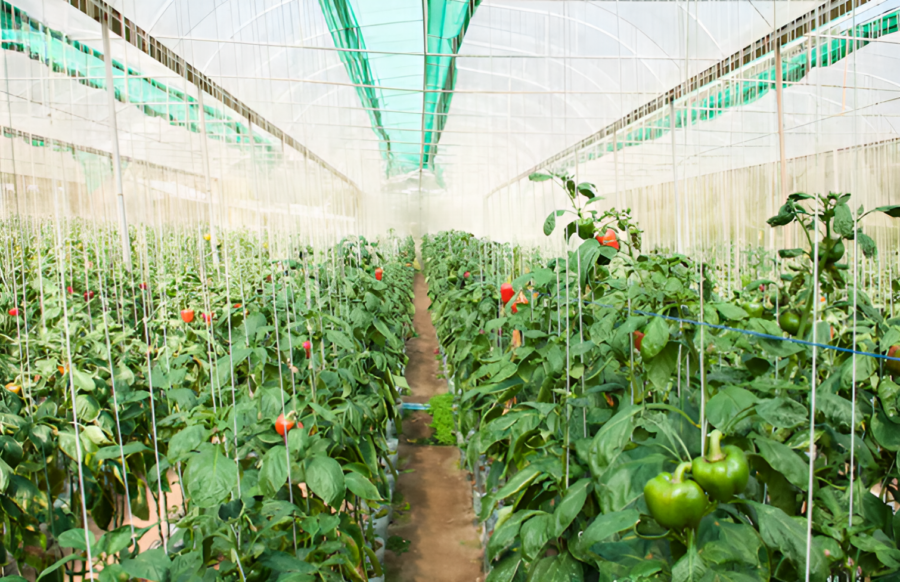
A stable microclimate inside the greenhouse speeds up growth and increases the number of crop turnarounds per season. A trellis height of 3 m is sufficient for vertical training of tomatoes, cucumbers and peppers. A tunnel width of 9.6 m gives room for several rows with working aisles.
A tunnel greenhouse suits the growing of:
- Tomatoes and cucumbers on a trellis;
- Peppers and aubergines;
- Strawberries and raspberries — in soil or on benches;
- Salad greens and herbs — up to 8–10 turnarounds per season;
- Seedlings for later planting out in the open field.
Sliding doors measuring 3×2.7 m allow compact machinery to drive in for crop work and harvesting. Ridge and side ventilation (manual or automatic) maintains the required temperature regime without sharp swings.
Who a tunnel greenhouse is the right choice for
A farm tunnel greenhouse covers the needs of businesses looking for a balance between investment and return. Low capital costs, year-round operation, protection from the environment, savings on resources and a good yield — five arguments that make this format the basic one for a farm greenhouse business.
When production volumes grow and precise microclimate control becomes necessary, a move to multi-span industrial structures can be considered. But at the launch and growth stage of a farm a tunnel greenhouse is a justified and proven choice.
NIVA GREENTECH has been designing and building farm tunnel greenhouses since 2007. To get the cost of your project, send a request for an individual estimate.