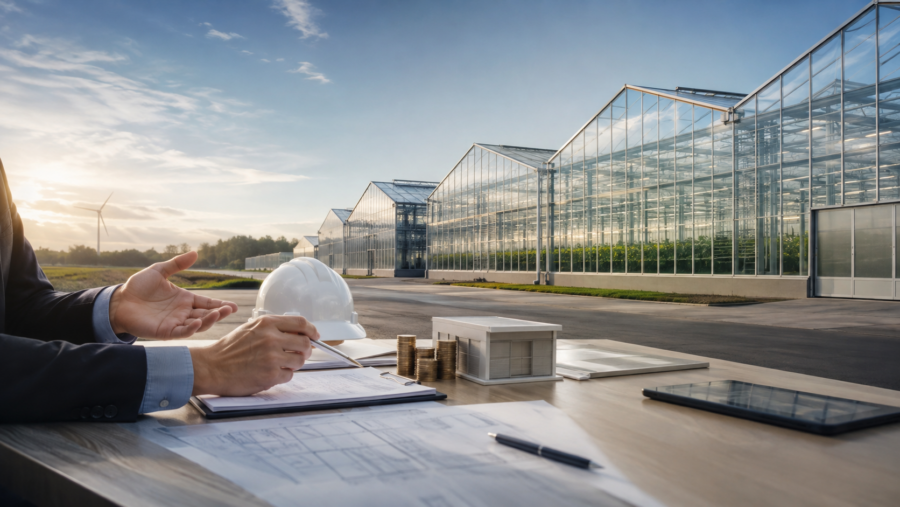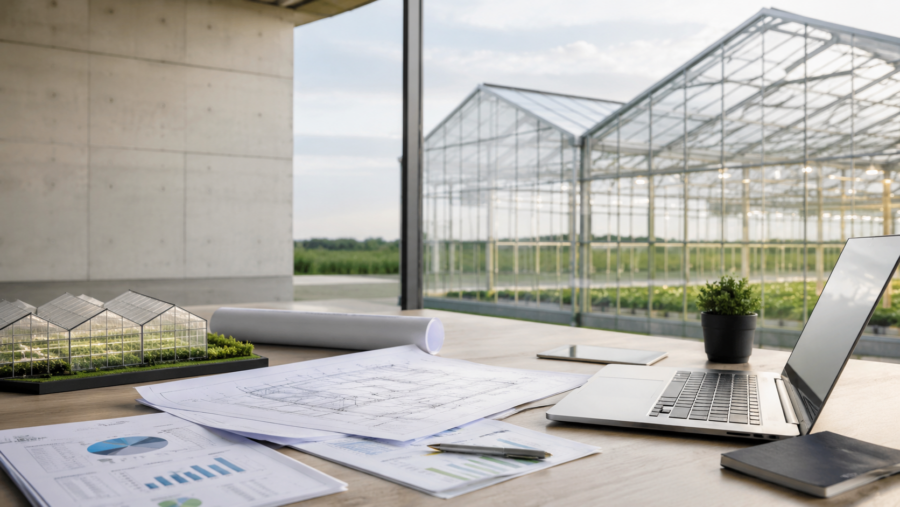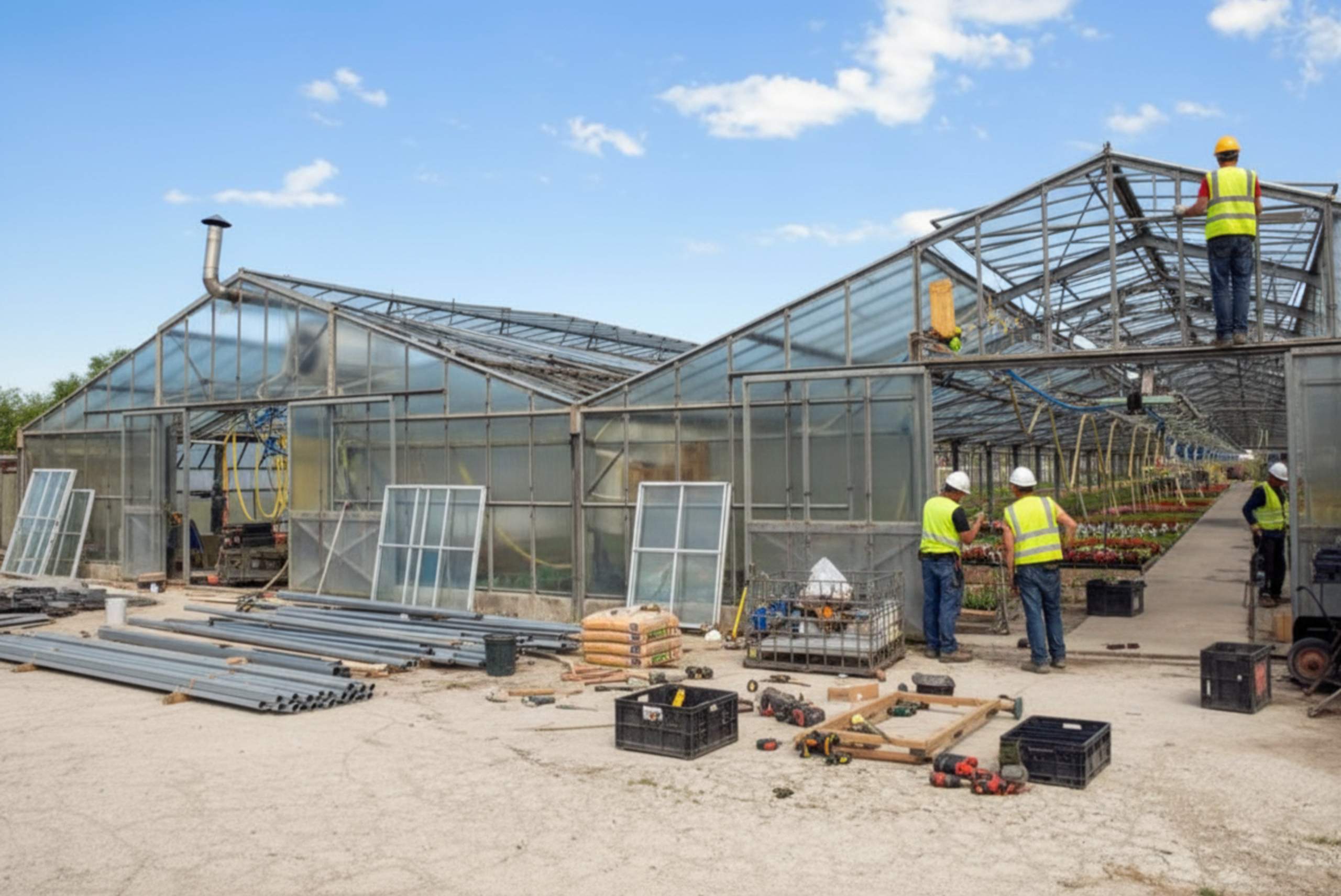
The decision to build a greenhouse complex is an investment of several million roubles. At those sums the word «turnkey» raises a fair question: what exactly does it include? Where does the contractor’s responsibility end and your own expenses begin — the ones that were not in the original budget?
In this article we look in detail at turnkey greenhouse construction — what the process consists of, where hidden costs arise and what to look out for when choosing a contractor. The article is based on the experience of NIVA GREENTECH, which has been designing and building greenhouse complexes at its own steel structures plant since 2007. More than 100 hectares of facilities have been delivered in that time.
What «turnkey» greenhouse construction means
Turnkey greenhouse construction means handing the customer a facility that is fully ready for operation. It is not a supply of a frame or a self-assembly kit, but a completed greenhouse complex where crops can be planted as soon as it is accepted.
The full cycle of work includes design for the particular site and crop, manufacturing of the steel structures, delivery to the site, installation of the greenhouse with heating, ventilation, drip irrigation and climate control systems, and commissioning and staff training.
The volume of work covered by the word «turnkey» differs substantially between contractors, however. Some include the foundation and the utility connections in the price, others leave this work to the customer. Proposals should therefore be compared not by the bottom-line figure but by the scope of work and the areas of responsibility.
Full package vs separate supplies: the difference
There are three scenarios by which a customer can get a greenhouse.
With self-assembly the customer buys a kit of steel structures and the covering, then hires a crew and deals with the design and the utility connections independently. The saving is 15–20%, but without experience of erecting industrial greenhouses the likelihood of mistakes is high — from a frame out of true to incorrect film tensioning and problems with drainage. All of this shows up in the very first season of operation.
With partial supply the contractor designs and manufactures the structure and delivers it to the site, but the installation stays with the customer. The cost is lower than the full cycle, but the warranty as a rule covers only the materials supplied. The contractor takes no responsibility for the quality of assembly.
A full turnkey cycle means that one contractor runs the project from the start to the handover of a working facility. The warranty in this case covers the structure as a whole, and if problems arise the responsibility lies with a single party.
What is usually not included and where hidden costs arise
Even in turnkey construction some work may fall outside the contract. Here is what is worth clarifying before signing:
- Site preparation and earthworks — levelling the ground, the foundation, drainage;
- Utility connections — electricity, gas and water up to the connection point;
- Logistics to the site — the cost of delivery depends on the region and the distance;
- Site improvement — access roads, fencing, perimeter lighting;
- Obtaining permits — if the greenhouse complex requires approval.
The fact that these items sit outside the contract does not mean the contractor is acting in bad faith. Site conditions differ from one facility to another, so such work is costed individually and shown as a separate line in the budget.
Stages of building a greenhouse complex
| Stage | What it includes | Indicative time |
| Design and approval | Technical specification, design documentation, siting, load calculations | 2–4 weeks |
| Manufacturing of the steel structures | Making the frame, assembling the covering and the engineering systems | 4–8 weeks (depends on the area) |
| Delivery to the site | Logistics of the package to the construction site | 1–2 weeks (depends on the region) |
| Installation of the structure | Assembly of the frame, installation of the covering, doors and vents | 4–12 weeks (depends on the area) |
| Installation of the engineering systems | Heating, ventilation, irrigation, climate control, electrics | In parallel with the installation |
| Commissioning and training | Start-up of the systems, testing, staff training | 1–2 weeks |
The times are indicative — for a facility of 1–3 ha. With a larger area each stage increases proportionally. The contractor draws up an exact schedule after surveying the site and approving the design.
Design and approval
Design starts with collecting the input data. The contractor needs to know the area of the future complex, the target crop, the climate zone and the characteristics of the site, including the soil type, the slope and access to utilities.
On the basis of this data the design documentation is developed with drawings of the structure, calculations of the snow and wind loads for the particular region, a specification of materials and diagrams of the engineering systems. Greenhouse design is a responsible stage, not a formality. An error in the load calculation leads to deformation of the frame in winter, and an incorrect ventilation layout leads to overheating and crop loss in summer.
A competent contractor offers a technical solution at this stage rather than simply taking the order. The type of structure — film, Venlo glass or tunnel — is selected according to the crop, the climatic conditions, the budget and the plans for scaling up.
Manufacturing and equipment
At this stage it is important to find out whether the contractor manufactures the structures itself or buys them from outside suppliers. An own steel structures plant provides quality control from raw material to finished product, allows non-standard elements to be made for the particular project and keeps to the schedule without depending on someone else’s production load.
When components are bought from third parties, the question of dividing responsibility between the supplier and the installation company inevitably arises. Warranty obligations in such a scheme are often blurred, so it is important that the warranty is single and covers the assembled structure.
Delivery and installation
The package for a greenhouse complex fills several trucks — steel structures, covering and engineering equipment. The cost of logistics to the site depends on the region and can significantly affect the final budget, so the delivery terms are best agreed at the contract stage.
Erecting an industrial greenhouse requires a specialised crew with experience of assembling greenhouse structures specifically. A contractor’s in-house fitters as a rule work faster and more accurately than hired subcontractors.
Installation times depend on the area, the type of structure and the weather. For industrial film greenhouses of 1 ha it is around 6–8 weeks. For Venlo glass greenhouses it takes longer because of the complexity of the glazing.
Commissioning and training
Once installation is complete the greenhouse complex is still not ready for operation. At the commissioning stage all the engineering systems are started and tested — heating, ventilation, drip irrigation, climate control and electrics. Specialists check that the automation responds correctly to changes in temperature and humidity.
Staff training is often overlooked when the terms of the contract are discussed. The farm’s employees have to be able to operate the microclimate systems and carry out basic maintenance. This point is worth writing into the contract separately.

How to choose a greenhouse construction contractor
Questions to ask before signing the contract
Before comparing proposals, ask every contractor the same questions. Here is the minimum list:
- Is there an own production facility or are the structures bought in?
- What experience is there of building greenhouse complexes? Can the completed projects be viewed?
- What exactly is included in the «turnkey» price and what is paid for separately?
- What does the warranty cover and how long does it last?
- Who carries out the installation — an in-house crew or subcontractors?
- What technical documentation is handed over after the facility is completed?
- Is there service support after installation?
Typical risks and how to reduce them
| What a reliable contractor includes | What others may leave out |
| Design for the particular site and crop | A standard design with no reference to the region |
| Manufacturing at an own plant | Buying from outside suppliers without quality control |
| Installation by an in-house crew | Subcontracting without supervision |
| A single warranty for the assembled structure | Separate warranties: for the profile, for the covering, for the work |
| Commissioning and staff training | Handover without starting up the systems |
| Service support after handover | No support after installation |
| Fixed deadlines in the contract with liability | Vague «approximate» deadlines |
The most common problems when working with a contractor are delays in installation, substitution of materials without the customer’s agreement and difficulties in claiming under the warranty after handover.
To minimise these risks the deadlines should be fixed in the contract with liability for delay. The specification of materials is attached to the contract, and any substitution is allowed only with the customer’s written consent. The wording of the warranty obligations should cover the assembled structure rather than individual elements.
Timelines and cost of building a greenhouse
The cost of building a greenhouse is made up of several components: the area of the facility, the type of structure (film, polycarbonate or glass), the composition of the engineering systems, the region of construction and the distance from the production site.
An exact price cannot be given without a calculation. Two greenhouse complexes of the same area in different regions and for different crops can differ in cost several times over, because they require different engineering, different materials and different logistics.
Construction times depend on the area of the facility, the season in which the work starts and the readiness of the site. As a guide, a greenhouse complex of 1–3 ha takes from 3 to 6 months from design to handover.
Exact figures can only be obtained after an individual calculation for the particular site, crop and objectives of the customer.
How to order greenhouse construction from NIVA GREENTECH
The process from enquiry to handover of a finished facility looks like this:
- You send a request for a calculation — a manager will clarify the area, the crop and the region.
- A specialist visits the site, or the survey is carried out remotely from your data.
- The design and a commercial proposal with a detailed budget are prepared.
- Approval and signing of the contract with fixed deadlines and a warranty.
- Manufacturing at our own plant, delivery across Russia and the CIS, installation, commissioning.
- Handover of the facility, staff training and transfer of the technical documentation.
Send a request for a calculation — a manager will get in touch, clarify the parameters of your project and prepare an individual budget.
FAQ
What is the minimum area of a greenhouse complex?
From 1,000 m². For smaller areas industrial construction is not economically viable.
Which regions can you deliver to and build in?
Across Russia and the CIS countries. The cost of logistics is calculated individually depending on the distance to the site.
What warranty covers the structure?
A single one — for the assembled facility as a whole. The period is fixed in the contract.
How long does construction take?
It depends on the area and the type of structure. As a guide, a facility of 1–3 ha takes from 3 to 6 months from design to handover.
Can the completed facilities be visited?
Yes, a list of completed projects with photographs is available in the completed projects section.
What if there are no utilities on the site?
Utility connections are discussed at the design stage. The contractor will advise what capacity is needed and help with the technical conditions.
Is staff training included in the price?
In turnkey construction training is part of the scope of work. Your employees will receive instruction on operating the engineering systems and on basic maintenance.
Is there service support after handover?
Yes. The terms of service support are set out in the contract — from warranty repairs to regular technical support.