Turnkey closed-loop greenhouses
Closed-loop greenhouses — a reproducible environment with every loop under control
Closed-loop greenhouses are used where repeatable conditions and limited exchange with the outside environment matter. These may be research facilities, original seed production, production of virus-free planting material, pharmaceutical projects and other tasks with elevated requirements for environmental control.
In such facilities sealing, climate control, air filtration, water treatment, recirculation, lighting and automation are combined into a single system. The set of systems is determined by the crop, the operating procedure and the biosafety requirements.

What this solution is suited for
Design and construction of a new industrial facility on a prepared site
Adding phases, new crops, engineering modules or production areas
A complex with its own boiler house, grading, packing, warehouse and logistics
Developing a concept with an assessment of profitability, payback period and project potential
Developing a production programme that accounts for regional demand, support measures and investment potential
Reviewing the original solutions, adjusting the equipment package and improving efficiency
Key advantages of the complex
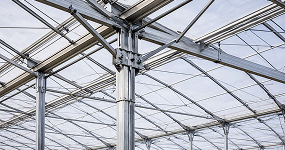
Precise load calculations for your construction area
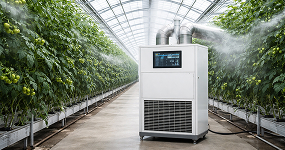
Temperature, humidity and ventilation kept within set parameters
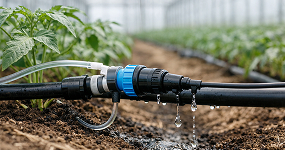
Stable plant nutrition without wasting water or fertilizer

Lower running costs through properly selected systems and materials
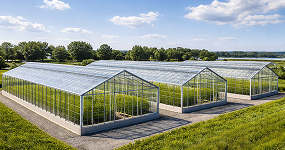
The project expands in phases without rework

Technical supervision and stage-by-stage acceptance

Support after launch: maintenance, diagnostics, recommendations
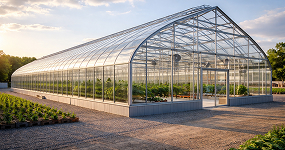
We do not just erect a frame — we bring the facility into operation
What a greenhouse complex includes
Included in the base project:
- ✓ Steel frame with load calculations
- ✓ Covering (film / glass / polycarbonate)
- ✓ Ventilation systems
- ✓ Heating systems and boiler equipment
- ✓ Irrigation and fertigation
- ✓ Automation and electrical equipment
Selected individually:
- + Supplementary lighting
- + Screening system
- + Logistics areas and vestibules
- + Coconut substrate
- + Hydroponics
- + Reservoir for rainwater storage
- + Additional engineering modules
- + Service hatches
- + Service area
- + Fifth-generation systems
Get the cost of your project
What the project cost depends on:How we work


Projects we have built
Here you can see a selection of the projects we have delivered.


Other greenhouses

Designed and manufactured to order using high-tech equipment and the Dutch system.

Larger and more productive than backyard greenhouses.

Designed for year-round commercial growing of crops over large areas.
When closed-loop greenhouses are needed
Closed-loop greenhouses suit clients who need not simply a harvest, but a reproducible environment with verified parameters. Typical applications:
- Production of virus-free planting material for potatoes, berry and fruit crops
- Meristem propagation and growing of elite seedlings
- Breeding centres working with parent lines and original seed material
- Pharmaceutical production using medicinal plants as raw material
- Research institutes and experimental stations with a phytosanitary regime
- Vertical farms and growth chambers with hydroponics or aeroponics
- CEA facilities that require repeatable conditions from cycle to cycle
All these tasks share one thing: control over pathogens, a repeatable microclimate and a sealed envelope. Without these conditions the result either cannot be verified or requires rework after every growing cycle.
Engineering systems of a sealed greenhouse
Closed-loop greenhouses differ from ordinary industrial facilities not in the frame itself, but in the set of engineering systems. The level of sealing, filtration and automation determines the cost of the facility, the time needed for certification and its suitability for a particular task.
Envelope and sealing
The frame is assembled from galvanized profiles produced at our own plant. Translucent structures (tempered glass, insulating glass units or polycarbonate) are installed with seals that prevent air leakage. All utility entries pass through sealed penetrations. An airlock or vestibule is provided for staff entry — this keeps the envelope intact every time someone goes in.
Climate control and ventilation
The specified temperature, humidity and CO₂ concentration are maintained inside the block. Air is recirculated through a heat recovery unit and, where necessary, through a heat pump or a chiller. The number of air changes and the direction of the airflow are calculated for the crop and the operating procedure. CO₂ enrichment is used with supplementary lighting and intensive photosynthesis.
Air filtration (HEPA H13–H14)
This is the key component of a closed-loop greenhouse. HEPA H13 or H14 filters are installed on the supply line: they retain fungal spores, pollen and most pathogens. The same stage is installed on the exhaust when the facility works with quarantine objects. The pressure drop across the filters is monitored by sensors and displayed in the SCADA system.
Water treatment and plant nutrition
Nutrition is delivered by a hydroponic or aeroponic system with dosing of the solution. EC and pH are measured in real time. Water passes through reverse osmosis and UV disinfection, which rules out infection entering with irrigation. Drainage is collected in a closed loop, disinfected and returned to recirculation.
Lighting and supplementary lighting
Growth chambers and vertical farms use LED grow lights with a defined spectrum and adjustable intensity. In tall greenhouse blocks with supplementary lighting, dynamic control by growth phase is added. The spectrum and the number of lighting hours are selected for the crop.
Automation and SCADA
All parameters are brought together in a SCADA system with logging and alarms. The operator sees the microclimate of each zone, the pressure drop across the filters, nutrient solution consumption and the status of the airlocks. Every deviation is recorded — a requirement both for certification and for the procedures of work with phytosanitary facilities.
Basic microclimate parameters
| Parameter | Typical value | Note |
|---|---|---|
| Air temperature | 18–28 °C | Depending on the crop |
| Relative humidity (RH) | 55–85 % | Depending on the growth phase |
| CO₂ concentration | 600–1200 ppm | Up to 1500 with supplementary lighting |
| Filtration class (supply) | HEPA H13–H14 | As required by the procedure |
| Air changes | 6–20 h⁻¹ | Depending on the task |
| Pressure difference (zone/airlock) | 10–25 Pa | For containment |
The exact values are selected for the crop, the operating procedure and the biosafety requirements.
Cost and lead times
The price of a facility depends on its area, the filtration class, the set of systems and the crop. Indicative lead times:
- A simple growth chamber with HEPA filtration and basic automation — from 8 months for design and construction
- A full sealed greenhouse with climate control, hydroponics and SCADA — 10–14 months
- Facilities for pharmaceuticals and work with quarantine pathogens — to an individual schedule that allows for certification
Costing is done on a project basis. A price per square metre cannot be given in advance for facilities of this kind: the requirements for filtration, sealing and automation vary too widely. Once the input data has been collected, an engineer prepares an indicative estimate and the list of engineering systems.
Questions and answers
Our contacts
Head office
- Moscow, Serebryakova proezd 14/15, office 10205
- info@nivagreentech.com
CEO — Elnur Abdullaevich Musaev
Get directions →Makhachkala branch
- Makhachkala, Rasula Gamzatova St. 12
- @ makhachkala@nivagreentech.com
Branch manager — Magomed Gadzhiev
Get directions →Far East office
- Vladivostok, Svetlanskaya St. 45
- @ vladivostok@nivagreentech.com
Head of division — Sergey Ivanov
Get directions →Tashkent office
- Tashkent, Amir Temur St. 107
- @ uz@nivagreentech.com
Representative — Alisher Karimov
Get directions →