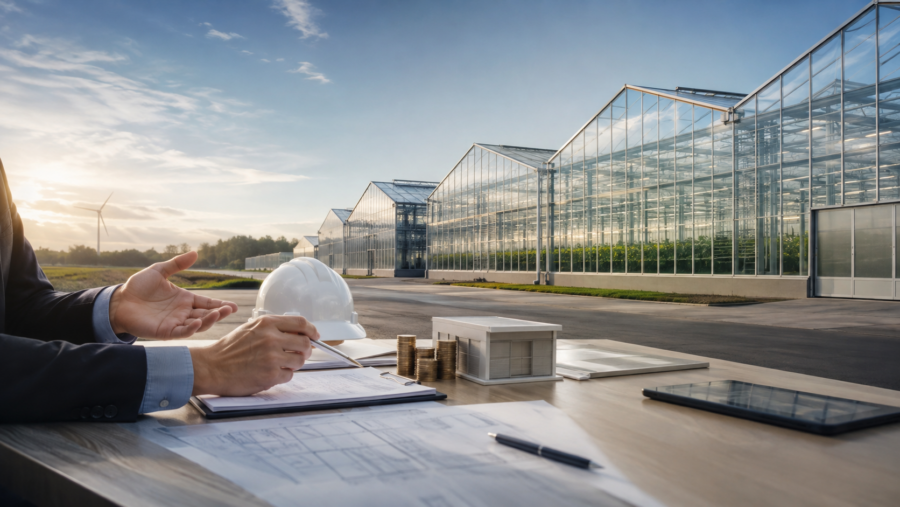
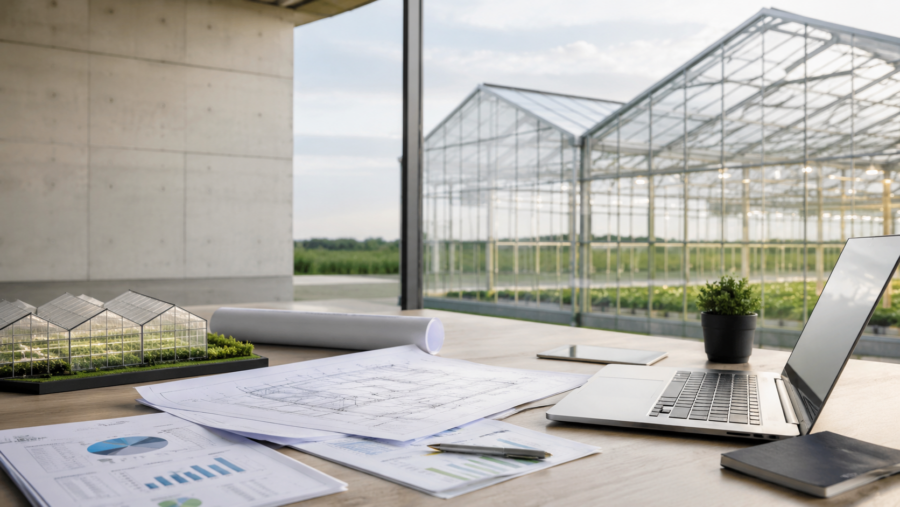
There is no universal price per m² for a turnkey industrial greenhouse. The budget is put together for a particular crop, site, region and operating regime: seasonal production or a year-round cycle. The same area with different engineering will give a different result.
The answer to the question of how much industrial greenhouses cost starts with clarifying the input: the crop, the area, the seasonality and the composition of the heating, irrigation, ventilation and automation. Below is a practical review for owners of agricultural projects, investors and technical clients.
Why the price of an industrial greenhouse cannot be given correctly without input data
The price of a turnkey industrial greenhouse is calculated from the design, not from a price list. Even on facilities of a similar area the budget can differ several times over. The reason is not a contractor’s mark-up but the equipment package: one facility is a simple seasonal tunnel, another is a year-round complex with heating, automation and supplementary lighting.
Six parameters shape the cost: the area, the crop, the region in terms of loads, the frame, the engineering and the level of automation. Universal ranges of «from … to …» mean nothing until the input data has been collected.
In brief, what the price of a turnkey industrial greenhouse depends on:
- The size and the layout of the blocks;
- The crop and the growing technology;
- The climatic loads in the region;
- The frame and the covering;
- Heating, ventilation, irrigation, fertigation;
- Automation, climate control, supplementary lighting;
- Installation, delivery and commissioning.
What makes up the cost of a turnkey industrial greenhouse
A full budget is made up of several groups of costs. The design and the engineering often take up more of it than the steel.
Dimensions, format and purpose of the facility
A large block gives a lower unit cost but raises the requirements for equipment and logistics. Cucumbers, tomatoes, leafy greens or seedlings — each crop needs its own ridge height, row layout and planting density. A berry tunnel and an intensive vegetable complex are designed differently.
Frame, covering and load calculations
The frame is made of galvanised steel with anti-corrosion protection. The profile section, the column spacing, the rafter system, the bracing and the foundation are selected for the snow and wind loads of the particular region. In northern regions the column spacing is reduced and the profile thickness increased — and that shows up in the budget.
The covering is a separate group of costs: double film, polycarbonate or Venlo glass mean different initial investment and different service life. The film option is described in more detail in the section on industrial film greenhouses.
Heating and the engineering systems
Heating is one of the most noticeable items in the budget, especially for a year-round cycle. A turnkey industrial greenhouse with heating includes a boiler house, the main circuit, heating pipes inside the block and automation. Ventilation, irrigation, fertigation, drainage, climate control and — with intensive technology — supplementary lighting and CO2 supply are calculated in addition.
The systems of an industrial greenhouse are put together for the task: the same area with manual irrigation and with automatic fertigation will give a different result. The equipment package is fixed in the design.

Film greenhouse, Venlo or tunnel: how the format affects the budget
The format of the structure changes the structure of the budget. Below is a comparison table without exact prices.
| Format | When it suits | Budget specifics |
| Multi-span film | Medium and large farms; cucumbers, tomatoes, leafy greens, seedlings | Moderate initial investment; the film has to be replaced on schedule; engineering to match the seasonality |
| Venlo glass complex | Large intensive projects, year-round cycle, high automation | Initial investment higher than film and polycarbonate; a separate budget for the automation |
| Farm tunnel | Berries, leafy greens, seasonal crops on medium areas | Economical start; limitations for a year-round cycle and intensive technology |
Table 1. Comparison of formats by their effect on the budget.
Multi-span film suits most vegetable projects. A Venlo glass complex suits large-scale automation. A tunnel is a practical solution for berries. There is no universal «best» format.
What a turnkey industrial greenhouse usually includes
Turnkey industrial greenhouses mean a full cycle of work: from design to commissioning. In a typical contract the construction of industrial greenhouses includes the following stages:
- Design of the facility and of the engineering systems;
- Calculation of the frame and selection of the equipment package;
- Manufacturing of the steel structures at our own plant;
- Supply of the covering, fasteners and components;
- Installation of the frame and the covering on site;
- Installation of the equipment: heating, ventilation, irrigation, fertigation, automation;
- Commissioning and handover of the facility to the customer.
Some stages — connecting external networks or the foundation, for example — may be passed to other contractors. The scope has to be clarified before the contract is signed: the same wording «turnkey» implies different volumes of work. The work is carried out through the section on construction of greenhouse complexes.
What data is needed for a preliminary estimate
To prepare a correct commercial proposal the following input data is required:
- The crop or crops to be grown;
- The planned area and the site for the greenhouse;
- The region of construction, the snow and wind loads;
- Seasonality: seasonal, extended-season or year-round cycle;
- The growing technology: substrate, hydroponics, gutters, trellis;
- Requirements for heating, ventilation, irrigation, fertigation and automation;
- Utilities on the site: electricity, water, gas or alternative heat sources;
- The planned start-up dates and the acceptable budget by stage.
On the basis of this input comes greenhouse complex design: load calculations, selection of the frame, the composition of the equipment, the layout of the blocks and the scope of work. The design of the facility is the document the budget is calculated from.
How to compare contractors’ proposals
The word «turnkey» means a different volume of work for different contractors. Comparing proposals by the bottom-line figure alone is the most common way to end up short at the installation or commissioning stage. Before ordering an industrial greenhouse, proposals are checked by their content:
- Steel: grade, section, anti-corrosion protection, column spacing;
- Covering: type, thickness, service life, manufacturer’s warranty;
- Heating: included or not, type of boiler house, length of the circuit;
- Irrigation and fertigation: class of system, dosing accuracy;
- Automation: manual or full, the control interface;
- Installation and commissioning: fully included or charged separately;
- Warranty: periods, what is covered, who fulfils the obligations.
If two proposals differ by 20–30% in the total, the difference is almost always in the equipment package. Identical prices for different scopes are a reason to ask again what exactly is included.
Typical mistakes in budgeting
Mistakes made by the customer at the pre-design stage are the most common source of overspending:
- Counting only the steel and forgetting the equipment — the typical step towards a «cheap» option;
- Ignoring logistics and installation — delivering steel structures to a remote region changes the budget noticeably;
- Buying a structure without a design — it later turns out that the frame cannot carry the design load;
- Comparing different packages as if they were the same — a film tunnel without heating and a Venlo with automation are not equivalent;
- Relying on price lists from open sources — those figures do not work without input data;
- Saving on commissioning — without it the engineering starts up with errors and the first cycle is lost to adjustments.

Frequently asked questions
Can a price per m² be given?
Not correctly. The cost per unit of area depends on the crop, the region in terms of loads, the composition of the engineering and the level of automation. The same square metre costs differently depending on what the project includes.
What affects the cost most?
Three groups of factors: heating and engineering for a year-round cycle, the frame designed for the calculated loads, and the level of automation. For a seasonal project the area and the covering come first. For a year-round one, heating and climate control.
How much does an industrial greenhouse with heating cost?
The budget is put together once the input data is available. Heating increases it noticeably: a boiler house, the main line, the heating pipes and the automation all have to be provided for. The exact figure depends on the area, the region, the heat source and the seasonality.
What does «turnkey» mean?
Usually design, manufacturing of the steel structures, supply of the covering, work on site and commissioning. Individual contractors include or exclude external networks, the foundation and the boiler house. The wording should be checked in the contract.
What data is needed for an estimate?
The crop, the area, the region, the seasonality, the growing technology, the composition of the engineering, the utilities on the site and the planned dates. This input is used to prepare the budget and a preliminary proposal.
Get an estimate for a turnkey industrial greenhouse
Planning to start a new facility or expand an existing one? Send us the crop, the area, the region, the operating format and the requirements for the engineering systems — we will prepare a proposal covering the structure, the package and the scope of work. An industrial greenhouse can be ordered once the design and the final budget have been agreed.