Industrial film greenhouses remain one of the most sought-after solutions for year-round growing of vegetables, leafy greens, seedlings and flowers on areas from 1,000 m². The combination of relatively low initial investment with the ability to scale quickly makes film structures attractive both to family farms and to large agricultural businesses. At the same time the choice of structure, type of film and engineering package directly affects the yield, the payback period and the running costs.
Where industrial film greenhouses are used
Film greenhouses are used in commercial growing for two main tasks: organising year-round production in regions with a cold climate and extending the season in southern zones. The choice between seasonal and year-round operation determines the requirements for the frame, the heating system and the type of film.
For year-round growing the structure is equipped with heating, climate control and supplementary lighting systems. Seasonal complexes as a rule manage with a lighter frame and minimal engineering, which reduces the initial investment.
Which crops are grown in film greenhouses
The main crops for industrial film greenhouses are tomatoes, cucumbers, sweet peppers, salad greens, seedlings and cut flowers. Each crop has its own requirements for the structure.
Tomatoes and cucumbers need a ridge height of at least 4–5 metres to allow vertical training and normal air circulation. Leafy greens and seedlings are less demanding of height but need precise control of temperature and humidity. Flower growers, besides the microclimate, place higher demands on the light transmission of the covering.
Area and configuration: from farm to industrial scale
Industrial film greenhouses are designed on a modular principle. The basic module is a single span from 8 to 12 metres wide. By joining modules together the area of the complex can be increased without limits on configuration.
For a farm complex of 1,000–3,000 m² a single-span or two-span structure is usually enough. Commercial growers from 1 ha upwards use multi-span complexes with a single climate control system and logistics aisles between sections. Modularity allows areas to be brought into operation in stages, spreading the investment over time.

Advantages of a film covering for an industrial greenhouse
The choice of covering material is one of the key decisions when designing a greenhouse complex. Film, glass and polycarbonate differ in cost, light transmission, service life and the conditions for replacement.
| Parameter | Film (light-stabilised) | Polycarbonate (twin-wall) | Glass (toughened) |
|---|---|---|---|
| Light transmission | 85–92% | 80–85% | 88–92% |
| Service life of the covering | 3–5 years (depends on the type of film) | 10–15 years | 25+ years |
| Cost of the covering (relative) | Low | Medium | High |
| Cost of the frame | Lower (light frame) | Medium | High (reinforced frame) |
| Speed of installation | High | Medium | Low |
| Replacement of the covering | Fast, without dismantling the frame | Requires partial dismantling | Complicated, element by element |
| Weight of the structure | Minimal | Medium | Maximum |
A film covering wins on the combination of initial investment and speed of commissioning. Glass provides the longest service life but requires a reinforced frame and considerably higher capital costs. Polycarbonate sits in between, although it loses transparency faster than glass over time.
Light transmission and microclimate
The type of film directly affects the light level inside the greenhouse and the temperature regime. Light-stabilised film retains its transparency throughout its service life thanks to UV stabilisers.
Reinforced film has higher tear strength, which matters especially in regions with strong winds. PVC film has good insulating properties but is inferior to polyethylene in light transmission.
For regions with a short daylight period, film with an anti-condensate coating is used; it reduces the formation of droplets on the inner surface and increases overall light transmission by 5–10%.
Cost of ownership: initial investment and running costs
When assessing the profitability of a greenhouse it is important to consider not only the construction cost but the total cost of ownership over the whole operating period. A film covering has to be replaced every 3–5 years, which creates regular running costs. Replacing the film, however, takes considerably less time than repairing a glass or polycarbonate covering.
The economics of a film greenhouse work in favour of businesses that plan phased expansion or operate with a limited starting budget. For a comparable area the capital costs of a film complex can be 2–3 times lower than those of a Venlo glass greenhouse, which substantially shortens the payback period.
Structural features of an industrial film greenhouse
Frame types and loads
The frame of an industrial film greenhouse is made of galvanised steel profile. The main parameters determined at the design stage are the snow and wind loads for the particular region of construction.
For regions with a high snow load a frame with reinforced rafter elements and a steeper roof pitch is used, so that the snow slides off naturally. In southern regions with strong winds priority goes to the wind resistance of the structure and the reliability of the film fixing.
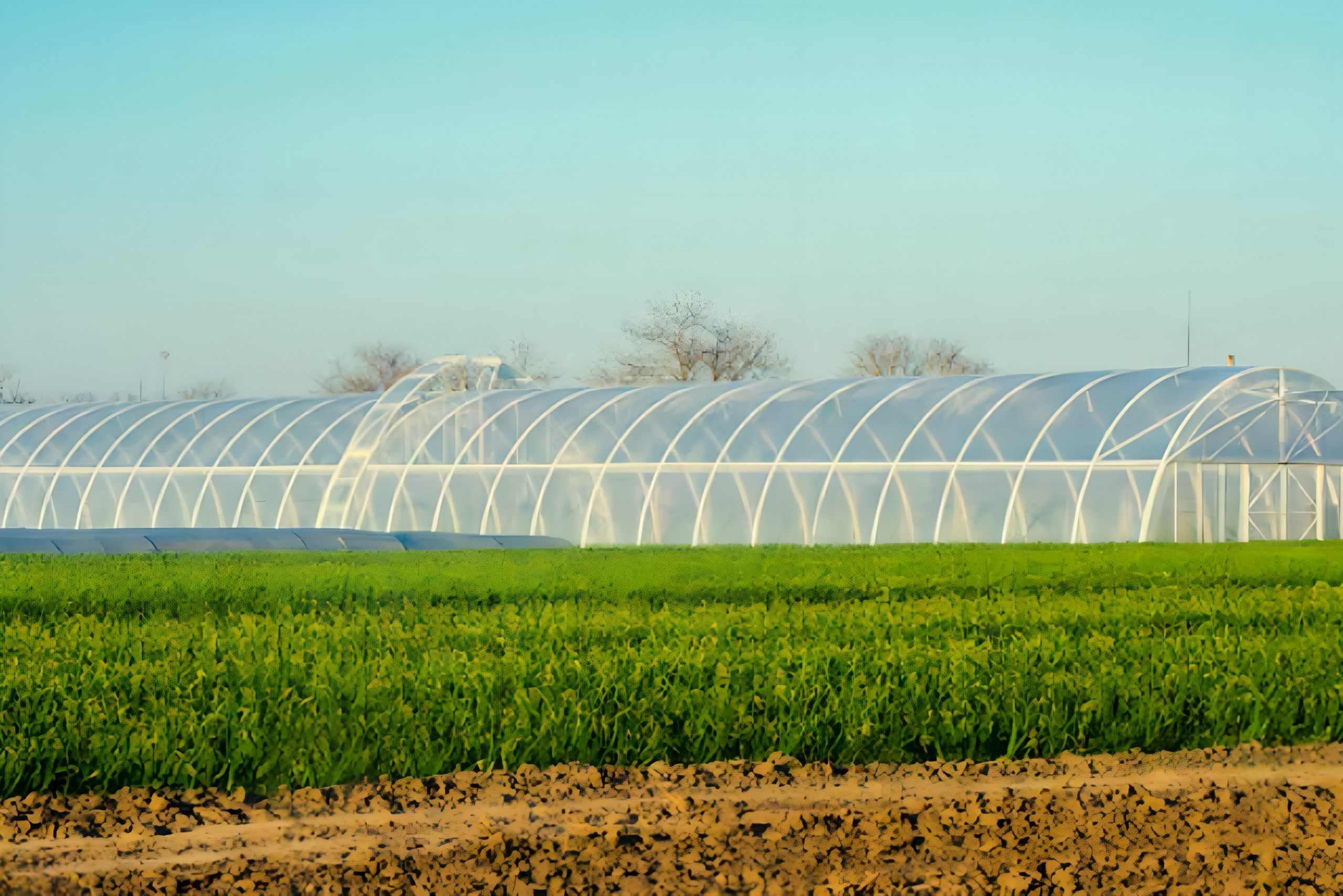
An arched roof shape provides optimal load distribution and makes tensioning the film easier. Tunnel greenhouses with an arched profile are widely used on farms thanks to their simple structure and reliability.
Climate control systems in film greenhouses
The microclimate in a film greenhouse is managed by several systems working together.
Ventilation is provided by side venting (roll-up side walls) and ridge venting (vents in the upper part of the roof). The combination of side and ridge venting creates a natural draught and removes excess heat efficiently.
The irrigation system in industrial film greenhouses is as a rule built on drip irrigation with the option of fertigation — supplying fertilisers together with the irrigation water. Fogging is used to maintain air humidity.
In winter the heating system becomes critical. The type of heating equipment is selected according to the available energy sources, the area of the complex and the target crop. Screens are installed in addition — retractable fabric sheets that reduce heat losses through the covering at night and are used for shading on hot days.
Typical defects and their causes
The same problems come up regularly in the operation of film greenhouses, and most of them can be prevented at the design and installation stage.
| Defect | Cause | Solution |
|---|---|---|
| Condensation on the inner surface of the film | Insufficient ventilation, no anti-condensate coating | Adjust the ventilation regime, use film with an anti-condensate layer |
| Film tearing at the fixing points | Incorrect tensioning, sharp edges on the frame, no protective padding | Fit protective tape on the frame, control the tension during installation |
| Film sagging under the weight of water or snow | Insufficient roof pitch, no supporting elements | Adjust the roof structure, install additional supports |
| Overheating in summer | Insufficient ventilation opening area, no screening | Increase the ventilation area, install shade screens |
| Accelerated ageing of the film | Using film without UV stabilisation, contact with aggressive substances | Use light-stabilised film, avoid contact with chemicals |
| Uneven microclimate across the greenhouse | Incorrect placement of the heating equipment, insufficient circulation | Recalculate the heating system, install circulation fans |
Condensation, film tears, overheating
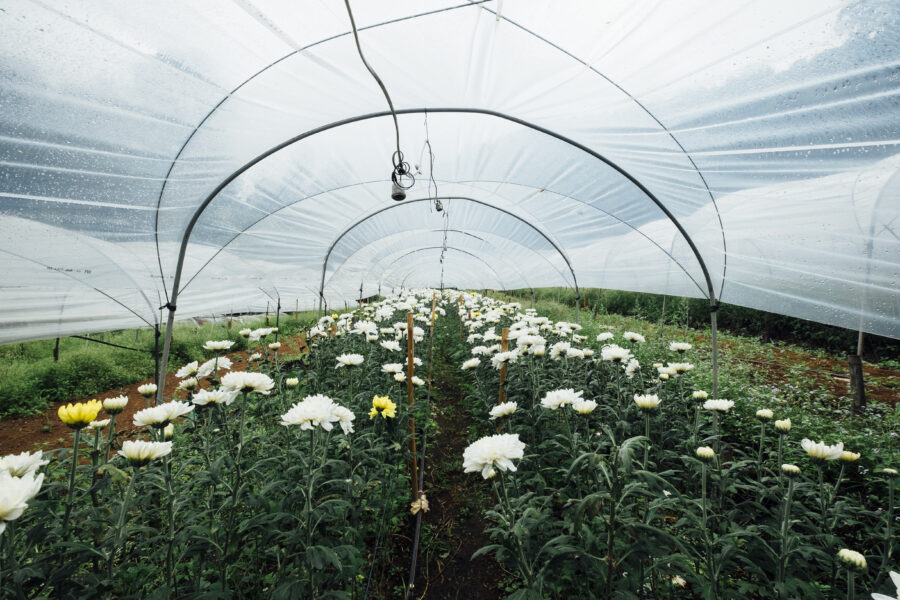
Condensation is the most common problem in film greenhouses. Water droplets on the inner surface reduce light transmission and can provoke fungal disease in the plants. The solution involves setting the ventilation regime correctly and using film with a hydrophilic coating that turns the droplets into a thin film of water running down the walls.
Tears in the film most often occur where it touches elements of the frame. With incorrect tensioning or without protective padding the film wears through at the fixing points, which breaks the seal. Prevention comes down to using protective tape on the frame and checking the tension during seasonal maintenance.
Overheating in summer occurs when the ventilation opening area is insufficient. For industrial greenhouses the ventilation area should be at least 15–25% of the floor area. Installing shade screens that reduce the intensity of solar radiation is an additional measure.
How to select a film greenhouse for your project
The configuration of a film greenhouse is determined by four main parameters.
The crop sets the requirements for the height of the structure, the training system and the microclimate. The region of construction determines the design snow and wind loads and the need for heating equipment. The area of the complex affects the choice between a single-span and a multi-span structure. The budget sets the priorities in the equipment package: you can start with a basic version and add to the complex as the business grows.
To get a cost estimate for a film greenhouse for a particular area and crop, send a request on the website of NIVA GREENTECH greenhouse complexes. A manager will clarify the parameters of your project, suggest the best configuration and prepare an individual budget. Delivery and installation are carried out across Russia and the CIS countries.
FAQ
What is the service life of the film on an industrial greenhouse?
Light-stabilised film lasts from 3 to 5 years depending on the region and the intensity of UV radiation. Reinforced film can keep its working properties for up to 6–8 years.
Can a film greenhouse be operated in winter?
Yes, provided a heating system is installed and film with improved insulating characteristics is used. Energy-saving screens are also recommended.
How does a film greenhouse differ from a Venlo glass one?
A film structure requires lower capital investment and is commissioned faster. A Venlo glass greenhouse provides a longer service life of the covering and stable light transmission, but costs considerably more.
What is the minimum area for an industrial film greenhouse?
From 1,000 m². For smaller areas industrial structures are not economically viable.
How often does the film need replacing?
The replacement interval depends on the type of film and the operating conditions. Standard light-stabilised film is replaced every 3–5 years. The replacement is carried out without dismantling the frame.
Will a film greenhouse withstand the snow load?
The frame is calculated for the snow and wind loads of the particular region of construction. The arched roof shape lets snow slide off naturally. For regions with extreme loads a reinforced frame is used.
What is the procedure for ordering a film greenhouse?
A request for a calculation, a survey of the site, preparation of the design and the budget, approval and signing of the contract, manufacturing, delivery, installation and commissioning.
Can the greenhouse be extended in future?
The modular structure allows the area to be increased by adding new spans to the existing complex without stopping production.