Plant protection in an industrial greenhouse is a separate engineering task. A closed environment and dense planting are ideal conditions for pests: a single whitefly in the corner of a compartment becomes a problem for the whole cycle within a week. Below we go through the principles of integrated pest management (IPM), biocontrol and work with the main pests.
Specifics of plant protection in an industrial greenhouse
A temperature of 22–26 °C and high humidity are optimal not only for the tomato but also for whitefly, two-spotted spider mite, aphids and thrips. Screens and ventilation reduce the introduction of pests but do not stop it. Every percentage point of loss in a marketable batch is real money per hectare per week.
The principle of integrated pest management (IPM)
IPM (Integrated Pest Management) is not a one-off release of Encarsia but a multi-level system with four stages. Integrated plant protection combines monitoring, prevention, biocontrol and selective chemical treatments. An IPM system is built around the crop, and integrated protection in industrial greenhouses also requires engineering preparation.
Monitoring and the economic threshold
Pest monitoring in a greenhouse means regular inspection and yellow sticky traps (one per 100–200 m²). The economic threshold is the population density at which losses exceed the cost of treatment. Decisions on releasing beneficials or applying an acaricide are taken from the monitoring data.
Prevention and phytosanitary control
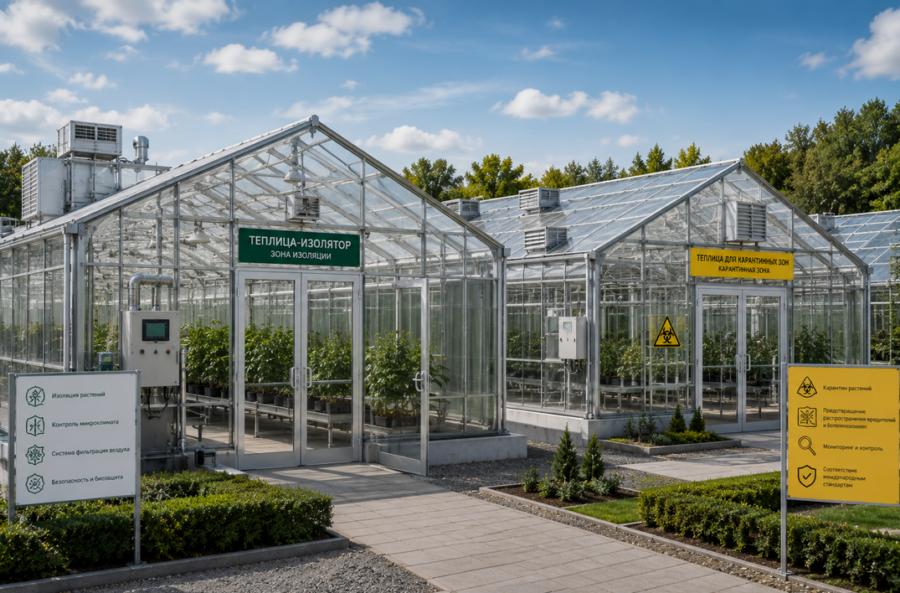
Quarantine of new material, treatment between cycles (steaming, disinfection) and filters. Preventing plant disease in a greenhouse costs 5–10 times less than fighting an outbreak.
Biological protection: releasing beneficials
Biological plant protection is the main tool in modern industrial greenhouses. Beneficials are released preventively: before the pest appears or at the first individuals. The rate depends on the species and the population density.
Chemical treatments — justified and selective
They are used when the economic threshold is exceeded. The products have to be compatible with the beneficials. Between a treatment and the resumption of biocontrol an interval is observed according to the half-life of the product.

Main pests of greenhouse crops and control measures
Whitefly: Encarsia formosa and yellow sticky traps
The greenhouse whitefly (Trialeurodes vaporariorum) and the tobacco whitefly (Bemisia tabaci) are among the most dangerous pests. Control measures against whitefly in a greenhouse: Encarsia formosa, yellow traps and, during an outbreak, systemic insecticides. Encarsia is effective against whitefly at 22–28 °C at a rate of 1–3 individuals per m² every 7–14 days. On tomatoes whitefly is usually found on the upper leaves, on cucumbers on the underside of the large ones. Biological protection against whitefly works when releases start preventively from the beginning of the cycle.
Spider mite: Phytoseiulus, Amblyseius and acaricides
The two-spotted spider mite (Tetranychus urticae) is a widespread problem in dry air and heat, and the control measures are standard: the predatory mite Phytoseiulus persimilis, Amblyseius swirskii and, during an outbreak, acaricides from different classes. Spider mite on cucumbers and on tomatoes is the main manifestation. The release rate for Phytoseiulus is 5–20 individuals per m² in the foci, up to 50 during an outbreak.
Aphids and thrips: beneficials and insecticides
For aphids — Aphidius colemani and lacewing. For thrips — Amblyseius, Orius laevigatus and, during an outbreak, blue traps and insecticides. On cucumbers thrips are dangerous as a vector of viruses.
Fungus gnats and leaf miner
Fungus gnats are a problem for seedlings, their larvae damage the roots. Control means yellow traps and nematodes. The leaf miner is monitored by the mines in the leaves; the parasitoid is Diglyphus.
Diseases of greenhouse crops and phytosanitary monitoring
Grey mould, powdery mildew, fusarium
Grey mould (Botrytis cinerea) appears at humidity above 85%. Powdery mildew affects cucumbers and tomatoes during temperature swings. Fusarium enters through the root and is carried with the substrate and the water.
Prevention and treatments
Climate control (humidity 65–75%, ventilation), removal of crop residues and fungicides where necessary. Biological products based on Trichoderma and Bacillus subtilis are used to prevent root rots.

How biocontrol works in an industrial greenhouse
Predatory mites and bugs
Phytoseiulus persimilis is a mite used against the spider mite. Amblyseius swirskii is an all-round mite for thrips and whitefly. Orius laevigatus is a bug used against thrips.
Parasitoids
Encarsia formosa is a parasitoid of whitefly eggs. Aphidius colemani parasitises aphids. Diglyphus parasitises the leaf miner.
Advantages of biocontrol for a commercial grower
Clean produce without pesticide residues, no resistance build-up and safety for the staff. The downside is that it requires a systematic approach and regular releases on schedule.
Typical mistakes in greenhouse plant protection
- Waiting for an outbreak and releasing Encarsia after the fact — biocontrol works preventively;
- Chemicals applied without checking compatibility with the beneficials;
- Ignoring trap monitoring — an outbreak is noticed 2–3 weeks later;
- No quarantine for new material — the pest gets into the system;
- Relying on a single group of beneficials — resistance and failures.
Frequently asked questions
When should beneficials be released — before the pest appears or at the first signs?
Preventively, from the first day of the cycle. A beneficial needs 2–4 weeks to build a stable population — by the time the first foci appear the colony should already be working.
Can biocontrol and chemical treatments be combined?
They can, but selectively, with products compatible with the beneficials. After treatment an interval of 2–7 days is observed, then the releases resume.
How often should traps be monitored?
At least once every 7 days, and every 3–4 days in the active season. What matters is the dynamics of the population, not the absolute figures.
What should be done during an outbreak — are there quick measures?
Contain the focus, apply an emergency treatment with compatible products and step up monitoring of the neighbouring zones. After the interval, release beneficials again at a higher than usual rate.
Plant protection in NIVA GREENTECH projects
In our projects for turnkey greenhouse complexes we build the engineering for plant protection in from the first stage: screens, water disinfection units, climate monitoring, quarantine rooms and areas for preparing beneficials. If you are planning construction or an upgrade, we will discuss the configuration for your crop. Examples of completed facilities are in our portfolio.